This first exercise asks us to draw a rough sketch of a landscape, to assess our preconceptions about the genre.
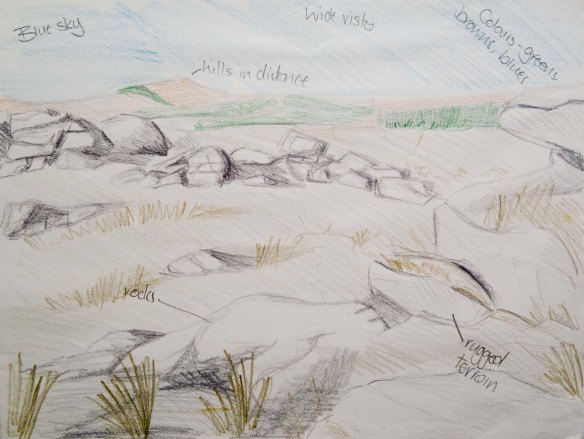
Although I am aware that a landscape is not necessarily a pretty image of the countryside, it was nevertheless Dartmoor that immediately came to mind when I initially started thinking about what landscape means to me, perhaps understandably as I do live only a short drive away. Interestingly, however, I actually live nearer to the sea but didn’t consider a seascape until I had been thinking for some time about different types of landscape, after cityscapes and urban detail images amongst others. I suspect the countryside image springs to mind first because the concept of landscape is inextricably linked with the history of painting, and those early definitions by the likes of Claud Lorrain and Nicolas Poussin depicting pastoral idylls are embedded deeper into our minds than we realise. Indeed, the Wikipedia entry for ‘Landscape Painting’ describes ‘natural scenery such as mountains, valleys, trees, rivers and forests’ but makes no mention of seascapes.
Thus far, my instinctive concept of a landscape seems fairly traditional. My sketch contains some of the typical elements of those seventeenth century genre-defining works such as the wide vista and front to back depth with hills in the distance, and is in the traditional landscape format with the long side of the paper on the horizontal. I also included a glorious blue sky. However, the wild beauty of Dartmoor calls for a more rugged approach than some of the more dreamy Romantic landscapes, even though many artists have painted it in this style, and my sketch contains jagged rocks and coarse tufts of grass. I also allowed it to be a pure view of the land with no people or man-made structures and thus have deliberately left an absence of narrative.
References:
https://en.wikipedia.org/wiki/Landscape_painting [accessed 16 June 2019]
 Rhonda's Landscape blog