Online Talk: Photography in the Age of Catastrophe

I attended the online talk Photography in the Age of Catastrophe which was a discussion which was part of Riga Photomonth, an international photography festival that takes place in Latvia. The talk was hosted by photographer Karolina Gembara from the Archive of Public Protests, Poland, in discussion with trauma photographer Nina Berman and journalist Tanvi Mishra from Caravan Magazine, India.

The talk opened by explaining that catastrophe in the photographic realm covers many events including:

  • COVID 19
  • war
  • conflict
  • activism
  • climate change
  • social unrest

Karoline explained that catastrophe events are not just those immediately apparent, but also include those occurring on a longer term trajectory such as the rise of the far right, climate change and fake news.

The discussion was engaging and interesting and stressed the expectations of photography to be involved in such issues because documenting being present carries a certain authenticity. The panel discussed how there is value embedded in the act of being present at such events when certain slices of society have ‘checked out;’ an act of privilege. In contrast, photographs confront and challenge viewers to act and take responsibility.

There was an interesting discussion on how dialogue around activism often talks of changing the world but sweeping change on such a large scale is usually unlikely and it is enough to make changes small enough to only affect one person. This echoes my approach to landscape photography; whilst there are numerous photographers currently addressing climate change as one large subject, I am more interested in picking out small changes and highlighting those.

An interesting point made was that the driving force behind activism is often that which is important but which cannot depicted in a photograph. Indeed, the issue being protested often becomes secondary to the battle over ‘territory’ (the streets) with the activists claiming space but the police trying to recover it. It is important for photography to teach, to help others learn via a number of images, rather than the photographer striving to create one iconic image.

A further point for me to bring to my own practice was that photography is not done when the picture has been taken. The photographer must then use the image to communicate further, and choose the method of doing so, whether that be in photobooks or some other medium. However, if photographers want their images to have more impact than merely sitting within the art world they must practice public speaking (as many photographers do not feel comfortable in this) and take their images into the community setting.
Assignment Four: Tutor Feedback and Reflection

I had laboured somewhat over Assignment 4, finding it difficult to pull together the various threads and concepts required to construct a major essay whilst job hunting through necessity and still working full time pending my imminent redundancy. However, I think I overcame the challenges to create a piece of writing that successfully conveys my ponderings around the crossovers between Land Art and photography.

My tutor feedback via Zoom was that the essay could stand as it is, should I choose to submit it unaltered. However, he also returned an annotated version of my essay with suggestions for my consideration. I had written in the first person for a personal perspective and he has suggested that I change to the third person. I can see that this makes for a more ‘academic’ piece of writing and intend to take up this suggestion. There are also suggestions on a couple of the opinions I raised, giving a different perspective. I will definitely review these and incorporate other viewpoints and considerations as well as looking at some of the suggested texts.

Family Secrets – Annette Kuhn

Annette Kuhn’s book Family Secrets Acts of memory and Imagination was recommended to me by my tutor. It is an accessible, semi-autobiographical look through both through her own family photograph album and those images that help to form collective memory; both memoir and cultural analysis through photographs.

A though-provoking read, the book speaks of the editing out from the family photograph album of events that do not fit the unspoken family narrative, of how the album is an edited ‘public face’ of the family that conceals secrets and undesirable events. The family album, she says, is not or the purpose of showing that one was once there but how we once were; an evocation of memory. I wonder if this is true today in the digital age? I feel that, in a world of social media and digitisation, the family photograph is intended more to promote the digital self, to create a self-centred ‘public face’ that is more about the individual than a family.

In her chapter on the Queen’s Coronation Kuhn notes the ‘vulgar’ rituals around public ceremonial events, of how collective memory and British culture is formed by these shared moments. I remember vividly the Queen’s silver jubilee of 1977, of dressing up, of garden parties, bunting and three legged races. These memories are part of the collective national culture but also part of my family’s narrative; the memory of my four year old sister biting a chunk out of a drinking glass triggered by photographs of the day but of course not recorded itself.

Kuhn notes sociologists Edward Shils and Michael Yound describing the ‘widespread adornment of houses and public places ….. a sacrificial offering’ and counters with her own, simpler explanation of the opportunity to forget one’s worries and ‘transform routine dullness and drabness into something special.’ It is an interesting discussion that makes me consider the way people hang England flags during a football World Cup, a subject I am interested in photographically.

Primarily, though, Kuhn’s book prompts the reader to think about their own family photograph album and question the meanings and motives behind the images. For me, it has prompted a deeper interest in my late mother’s old albums: the seemingly random order in which photographs are stuck in; the strong emphasis on her school days; why she kept photographs of old friends she had long lost touch with; the special outfits her daughters (myself and my sister) were dressed in. The stories behind he photographs are certainly more complex than I had previously considered and contain many more layers of meaning and lost memories. Since reading Family Secrets I shall spend some time going back through the albums and thinking about the hidden meanings behind some of the images, the cultural background, some of the people involved including the photographer, and the significance of what may have been omitted from the picture.

Kuhn, A. (2002). Family secrets: acts of memory and imagination. London; New York: Verso.

Research – Roger Ackling

Roger Ackling was a British artist who was a close friend and collaborator of Land Artists Richard Long and Hamish Fulton. He is best known for his works made by using a hand-held magnifying glass to concentrate sunlight into scorch marks on found detritus and driftwood.

Roger Ackling Voewood (2013) sunlight on wood, courtesy of Annely Juda Fine Art
Voewood, 2013
Weybourne, 1992

The end result is primitive and deliberately ambiguous, simple yet meticulous in its creation; a very basic form of photography. Ackling’s work explores both time and place and is the result of the two coming together on a particular occasion. Yet they also give the impression of being something created in another era, carrying a sense of alchemy and ancient mysticism. In addition, I think there is something of the event of creating the work here, similar to that of the creation of Land Art, despite Ackling’s protestations that this is not what his work is.

For me, it is both the method of using the sun directly as a method of creating the ‘image’ and the act of creating the works in the field which draws me to Ackling’s work, along with the use of an object from the land itself as the starting point for the work. It is the subtlety of humankind using nature on a very modest level, of being immersed in nature and using the Earth itself as a method of creating art. I find it fascinating how such modest and understated creations can possess such profundity and mystery, and contain layers of hidden narrative about the landscape, both in the history of the object itself and in the creation of lines ‘written’ from left to right on a sunny day.

Weybourne, 1992 by Roger Ackling :: | Art Gallery of NSW [Accessed 1 May 2021]

Roger Ackling: Simple Gifts, Annely Juda Fine Art | Culture Whisper [Accessed 1 May 2021]

Exhibition: Leonor Antunes

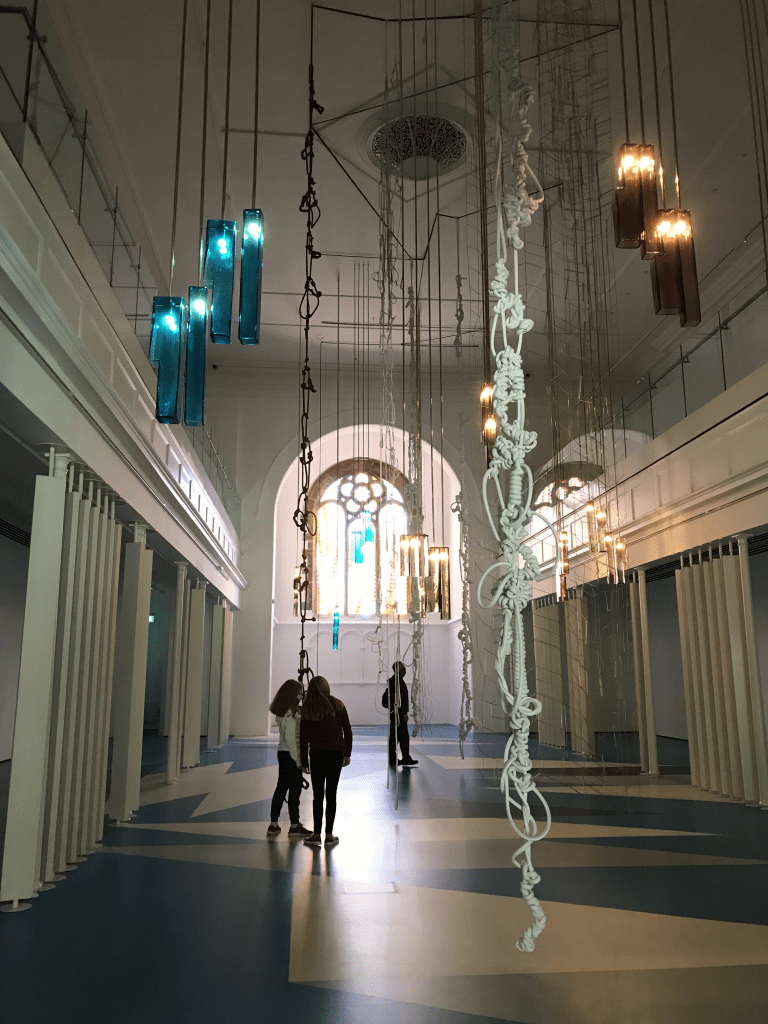
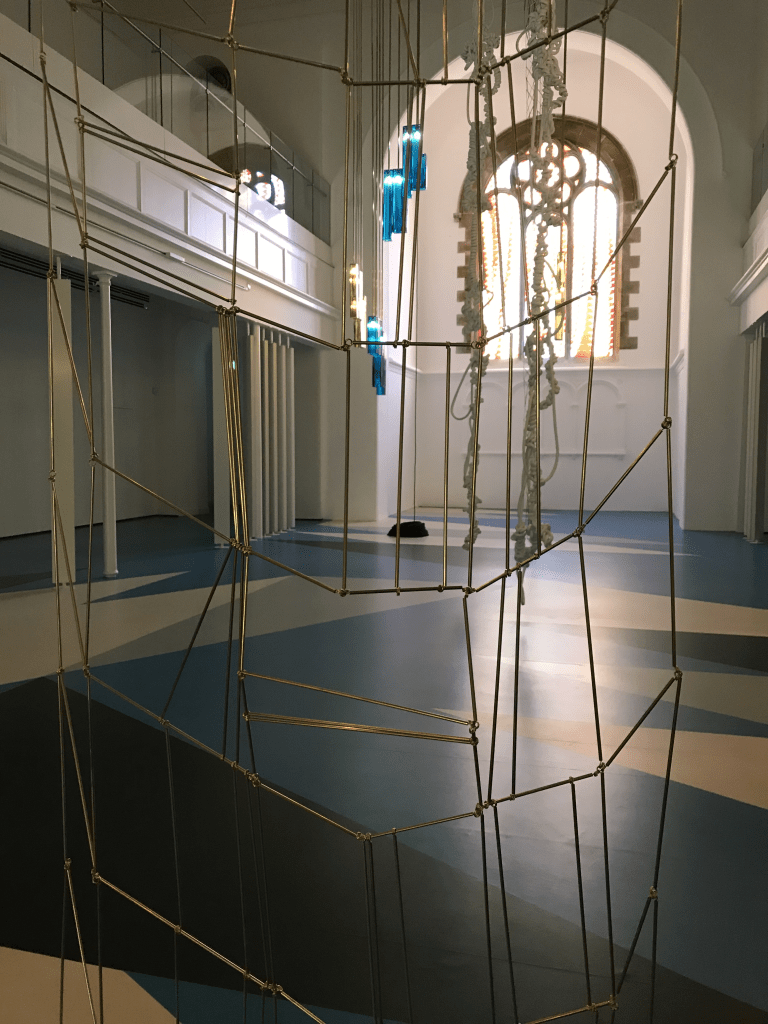
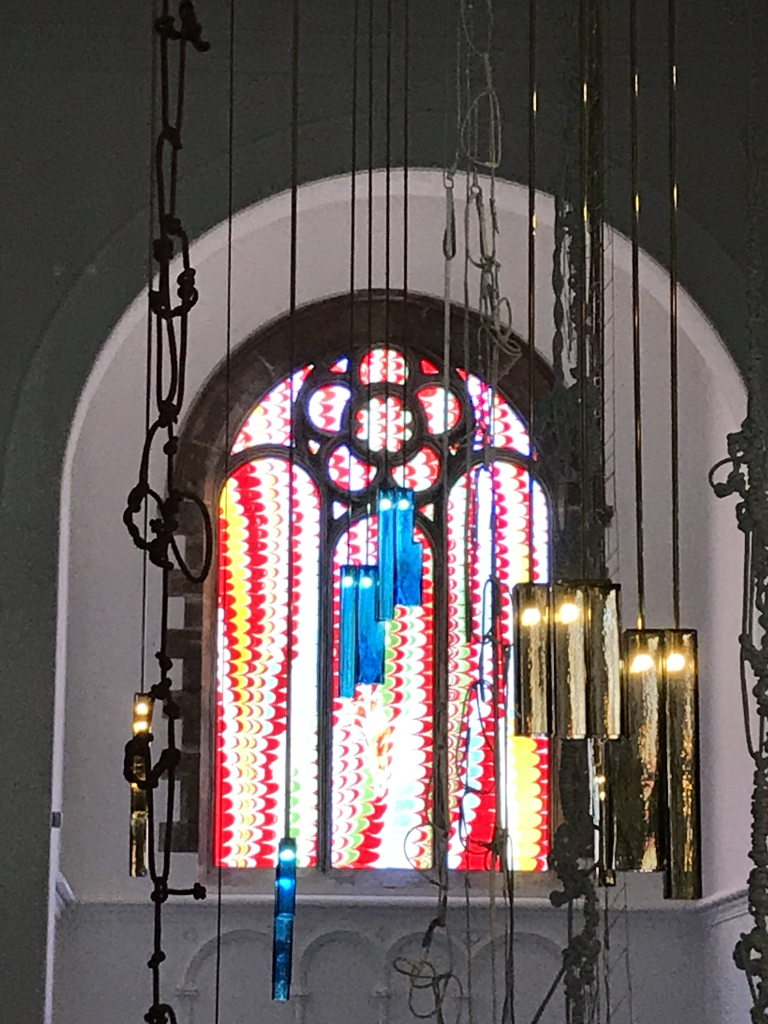
Leonor Antunes is a Portuguese artist whose work Sequences, Inversions and Permutations is currently showing in St Luke’s church, Plymouth.

Antunes uses the physical building as an extension of her sculptures; they have been created specifically to exist in this space and it is clear that there is a dynamic tension between the two. Ropes, leather and Murano glass lighting hang from the ceiling, echoing the vertical lines of the columnar architectures, while metal netting mirrors the pattern on the floor, which she also designed along with the stained glass window. Knotted ropes provide a nod to Plymouth’s maritime identity and its historical ropemaking tradition. Each piece uses traditional materials in a nod to historic methods of production and as a foil to our ever-advancing digital world.

The overall result is serene and reverent, blurring the lines between art and architecture by using carefully chosen materials, movement, space, pattern, light and shadow to create interaction between the two.

Research: Deborah Bright

Deborah Bright is an American artist, photographer, writer and professor. Her work on the settlement of the Pilgrim Fathers on America’s East Coast in the 1600s interests me, both in its execution and the historic links to my home town, Plymouth.

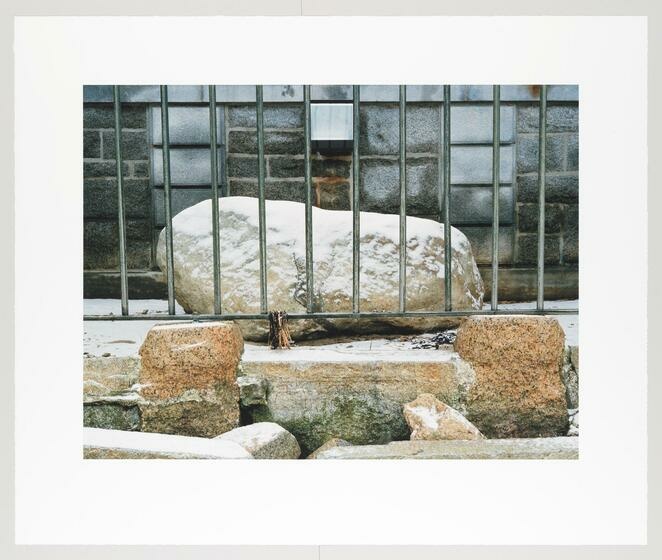
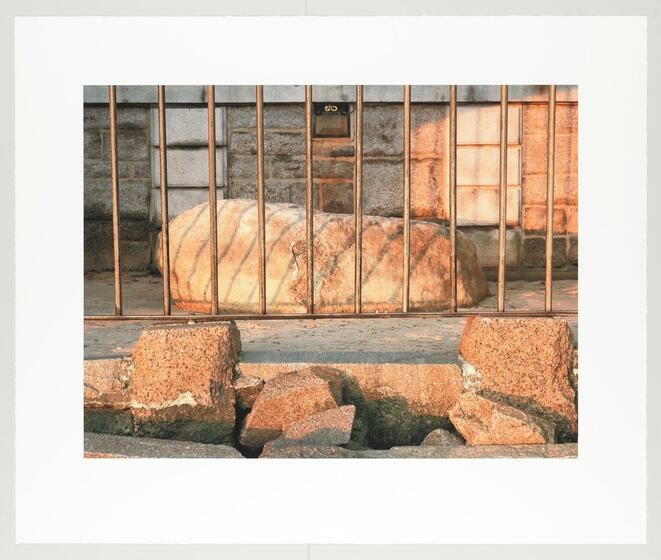
Glacial Erratic (2000-03) depicts the tourist attraction Plymouth Rock in Massachusetts. According to legend, the rock is where the Pilgrims landed when they first set foot on American soil.

Glacial Erratic; Plymouth Massachusetts (snowfall)
2003
Glacial Erratic; Plymouth Massachusetts (sunrise)
2002


Bright produced nine images of the rock taken at different times of the day and year. The rock itself appears to be insignificant, yet Bright manages to instil her works with meaning and symbolism. The title Glacial Erratic is a term for an Ice Age rock that was deposited during the glacial retreat into a non-native region, effectively a stranger amongst the surrounding rocks; different in composition, shape and colour. The link with the Pilgrim immigrants is therefore immediately evident.

2020 was the 400th anniversary of the Pilgrims’ ship the Mayflower’s sailing, and there has been a lot of discussion here in Plymouth about the consequences of their colonisation of the area, naming it New England in a claim to the territory. The history has previously been portrayed from a mainly one-dimensional perspective, largely ignoring the consequences on the Wampanoag Nation who ultimately lost their lands and homes despite initially working together with the Pilgrims.

Bright’s work reflects on the portrayals of the Pilgrims as founders of America by depicting the rock behind bars, thus questioning the ‘freedom’ assigned to them by historical records and questions the narrow white, male origin of America’s mythical foundation. The rock is paraded as a national symbol of liberty, discovery and adventure, yet Bright turns this around by enslaving it in a confined cell, thus questioning the motifs behind America’s ideological depiction of its past.

Deborah Bright | Whitney Museum of American Art

Research: Zoe Leonard

Zoe Leonard is an American artist working mainly with sculpture and photography. Based in New York, her work explores themes such as loss, the passing of time, displacement and repetition.

For her 1995 work Strange Fruit, in response to the death of a close friend, she sewed the skins of fruit such as oranges, lemons and grapefruit together with wire, thread and zips, in a nod to vanitas still life paintings of the 16th and 17th centuries, suggesting the fleeting and finite nature of life. The work evolves and decays as time passes until eventually it is gone, a theme which I am very interested in and which is reflected in my work depicting the imprints left by human activity on grass.

See the source image

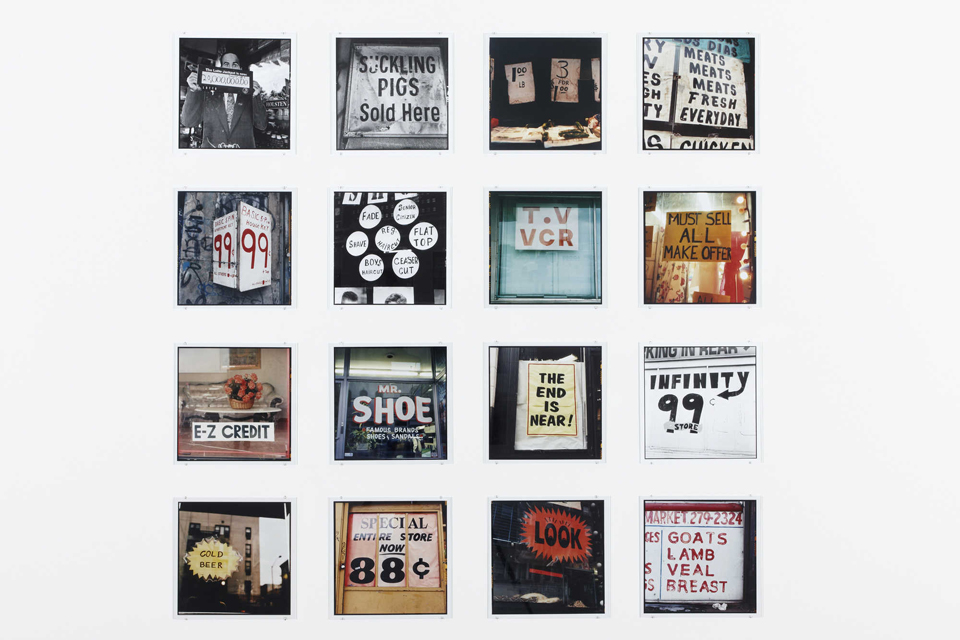
She continues her interest in the passage of time in her series Analogue, this time investigating the disappearing landscape of 20th century urban life with photographs of shop fronts, taken on a vintage 1940s Rollaiflex camera to reflect the nature of obsolescence in an increasingly globalised economy. Tracing the circulation of recycled merchandise, Leonard visited roadside markets in locations such as Cuba, Africa and the Middle East and presented the resulting images in a series of repetitive grids.

See the source image

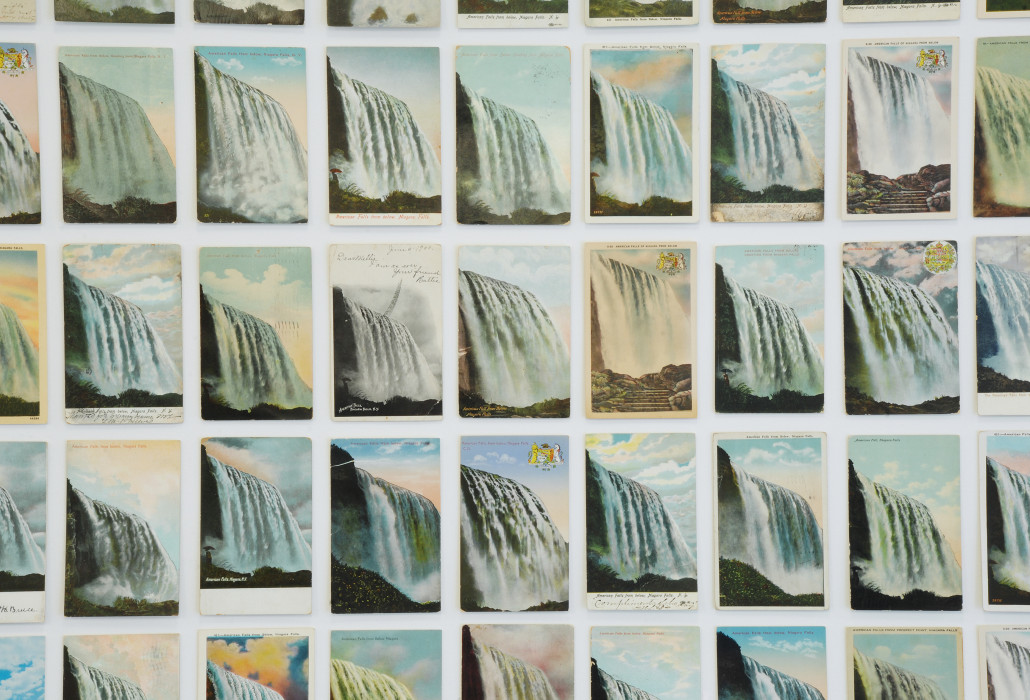
For her 2008 work You See I Am Here After All, she takes a different view on the passage of time, this time presenting thousands of postcards she has collected of Niagara Falls, dating from the early 1900s to the 1050s. This work is a commentary on the commoditising of nature by the tourist industry, showing how repetitive depictions of famous landmarks were used by the industry to infiltrate iconic symbols from nature into mass culture, and on the generic depictions of the picturesque.

Leonard_YouSeeIAmHere 2

Philadelphia Museum of Art – Collections Object : Strange Fruit (philamuseum.org) [Accessed 2 April 2021]

Zoe Leonard: Analogue | MoMA [Accessed 2 April 2021]

Zoe Leonard: You See I Am Here After All, 2008 | Exhibitions & Projects | Exhibitions | Dia (diaart.org) [Accessed 2 April 2021]

Research: Anselm Kiefer

Anselm Kiefer is a German painter, sculptor and photographer focusing on mixed media methods. His landscapes address themes incorporating events from German history such as the Holocaust and Nazi rule.

His work is visceral, unflinching and raw; the antithesis of the Picturesque. His paintings are almost monotone, deeply textural and semi-abstract, the identification of a landscape sometimes only possible through a positioning of lines.

The Milky Way by Anselm Kiefer, mixed media painting.
The Milky Way

Throughout his work we see evidence of destruction: churned, furrowed earth; black, billowing smoke; ruined wastelands; gritty textures; and physical deterioration of the artwork. His photographic works are sometimes from his own images, sometimes appropriated and doctored, often allowed to deteriorate almost beyond recognition. The photographs were the first of Kiefer’s works I discovered and, without knowing anything about him, I was immediately reminded of wartime landscapes, of trenches, rutted earth and destruction as well as the passage of time. It is impossible to view these images without some sort of response on a psychological level, even without knowing what they represent.

Anselm Kiefer: a beginner’s guide | Blog | Royal Academy of Arts [Accessed 28 March 2021]

Anselm Kiefer born 1945 | Tate [Accessed 28 march 2021]

Book: Shadow Catchers

This book was recommended to me by my original tutor for this course, Andrew Langford. It explores the work and practices of five artists working with camera-less photography and presents a brief history of the methods of working within this genre, from William Henry Fox Talbot to the modern day via the the likes of Man Ray and Frederick Sommer.

The techniques featured include cyanotypes, photo grams, chemical grams and dye destruction prints. What strikes me in particular about each of these methods is that the process is as much a part of the work as the finished piece itself, much like some of the other practitioners I have researched earlier in the course, particularly in Land Art. There is very much a sense of performance in the life-sized human photograms by Floris Neusüss, for instance.

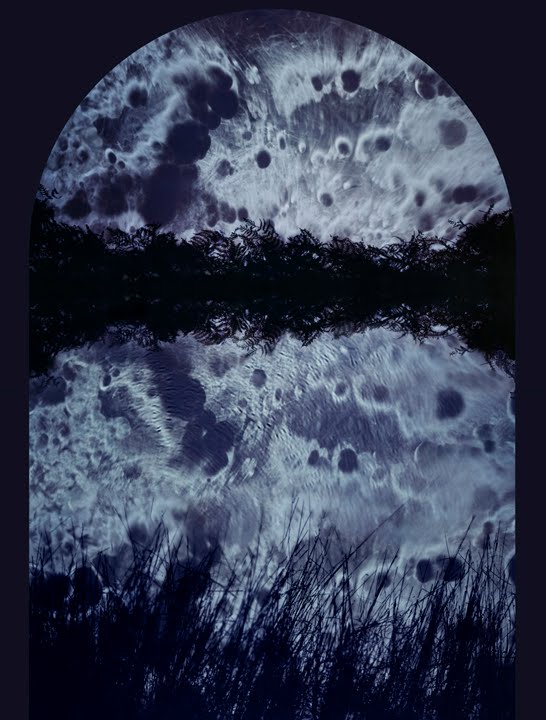
I was particularly interested in the work of Susan Derges. Based in Dartmoor, she spends time in the field and in her studio creating ethereal landscapes that feature plant photograms, images taken by placing photographic paper in the River Taw at night and creating an image with flashlight. The result is a sublime collection of landscapes that seem not quite real, but equally not completely fictional. In her series Arch, she depicts the four seasons, each framed by a black arch with a silhouetted foreground, giving the viewer the impression of looking through to a new space, like some magical secret garden.

Arch 2 (winter) 2007-08

Barnes, M. (2012) Shadow Catchers Camera-Less Photography (2nd ed.). London: Merrell Publishing

Research: Hans Haacke

Hans Haacke is a German-born artist currently residing in New York City. His work is frequently a commentary on social, political and economic systems, such as his work highlighting GENCOR’s treatment of its on strike gold and coal miners, where they were hit with tear gas, firearms and dogs, evicted from their quarters, and in many cases fired from their jobs. Haacke’s response was to create a corporate-looking display that appears to be a display from a trade show or some high profile event which, on closer inspection, depicts the affected black workers and tells their story.

He also makes commentary on the art world with work that directly references the likes of Duchamp and Magritte, particularly referencing Duchamp ‘ready-mades’. Fully aware that the ready-makes are now revered objects in their own right, Haacke also references Duchamp’s focus on the power of context and the way he upended universal assumptions.

I am particularly interested in Haacke’s work from the 1960s and early 1970s where he brought different plants into the gallery environment. I used grass as a photographic receptor for Assignment five and am considering ways in which the concept could be developed further. Haacke was interested in plants as a way of exploring unregulated growth and in how artworks can evolve and grow naturally. The work is allowed to grow its own way independent of the artist and gives the art a random, constantly shifting factor, thus marking the passage of time. This is an area that appeals to me and is something I would like to explore in my future work.

In this installation view from the exhibit “Hans Haacke 1967,’’ a balloon floats in place, held by gravity and a jet of air, and the cone is a mound of growing grass.

Hans Haacke 1967 exhibition at MIT

The heyday of Hans Haacke – The Boston Globe [Accewssed 15th March 2021]

Grasskamp, W. Nesbit, M. Bird, J (2004) Hans Haacke. New York: Phaidon