
Deborah Bright is an American artist, photographer, writer and professor. Her work on the settlement of the Pilgrim Fathers on America’s East Coast in the 1600s interests me, both in its execution and the historic links to my home town, Plymouth.
Glacial Erratic (2000-03) depicts the tourist attraction Plymouth Rock in Massachusetts. According to legend, the rock is where the Pilgrims landed when they first set foot on American soil.
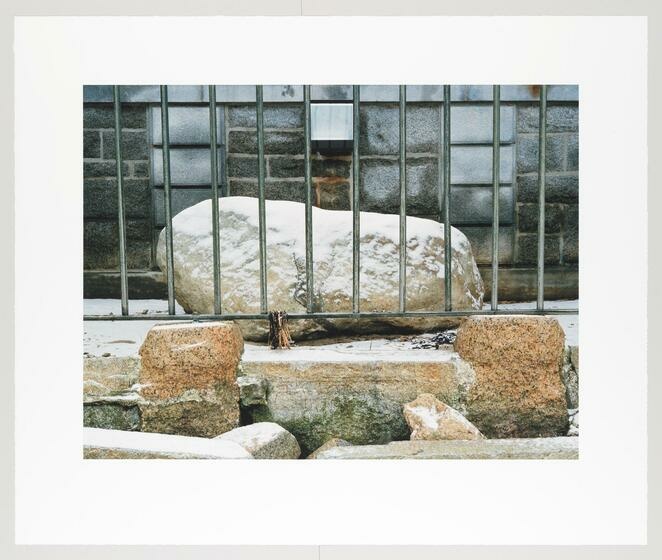
2003
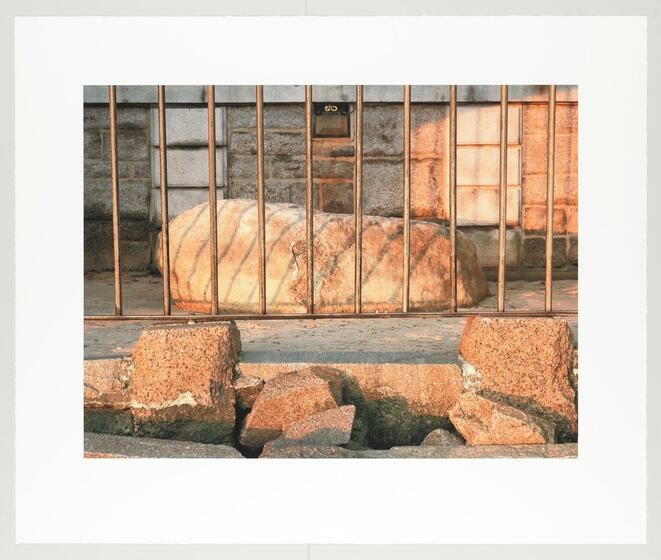
2002
Bright produced nine images of the rock taken at different times of the day and year. The rock itself appears to be insignificant, yet Bright manages to instil her works with meaning and symbolism. The title Glacial Erratic is a term for an Ice Age rock that was deposited during the glacial retreat into a non-native region, effectively a stranger amongst the surrounding rocks; different in composition, shape and colour. The link with the Pilgrim immigrants is therefore immediately evident.
2020 was the 400th anniversary of the Pilgrims’ ship the Mayflower’s sailing, and there has been a lot of discussion here in Plymouth about the consequences of their colonisation of the area, naming it New England in a claim to the territory. The history has previously been portrayed from a mainly one-dimensional perspective, largely ignoring the consequences on the Wampanoag Nation who ultimately lost their lands and homes despite initially working together with the Pilgrims.
Bright’s work reflects on the portrayals of the Pilgrims as founders of America by depicting the rock behind bars, thus questioning the ‘freedom’ assigned to them by historical records and questions the narrow white, male origin of America’s mythical foundation. The rock is paraded as a national symbol of liberty, discovery and adventure, yet Bright turns this around by enslaving it in a confined cell, thus questioning the motifs behind America’s ideological depiction of its past.
 Rhonda's Landscape blog