Exercise 1.9: Visual Research and Analysis – Social Contrasts

his exercise asks us to find different social perspectives of the same place.

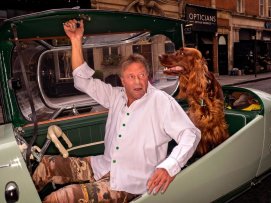
Dougie Wallace is a British street photographer who has lived in Blackpool and Shoreditch.  His images of London show contrasting sections of society.  His images are brash and bold; his subjects grotesque and larger than life.  His project Harrodsburg focuses on the mega-rich of Kensington, a freak-show of bad facelifts and lurid sartorial tastes.  His objective is to focus on ‘the one per cent’ in an effort to highlight the disparity in society.  It is not a sympathetic portrait of the wealthy elite but personification of the monstrousness of the vast wealth of some in modern society while others are living in abject poverty.
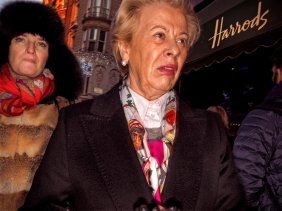
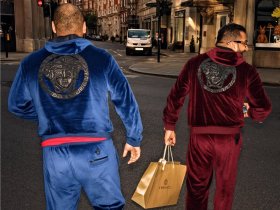
        made in chelsea- gauguin.jpg           made in chelsea-versace twins.jpg

        made in chelsea-Messerschmitt.jpg          made in chelsea-2784.jpg

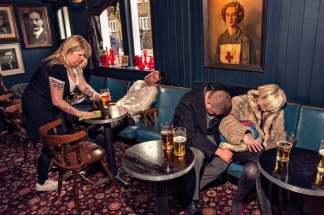
In contrast the subjects of Wallace’s Shoreditch Wild Life seem less glossy, less shiny, even if they can be just as gaudy.  Any softness in their faces is the result of a life well-lived rather than of artificial fillers and they seem somehow more authentically  human.  This is not a contrast of rich versus poor although wealth or lack of is an obvious factor, but more a contrast of class.

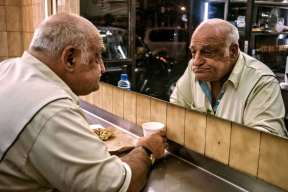
shoreditch exhibition-the royal oak.jpg        shoreditch_new_2012-cabby hot salt beef.jpg

shoreditch brick lane-greedy toy granny.jpg        sleep shoreditch exhibition.jpg


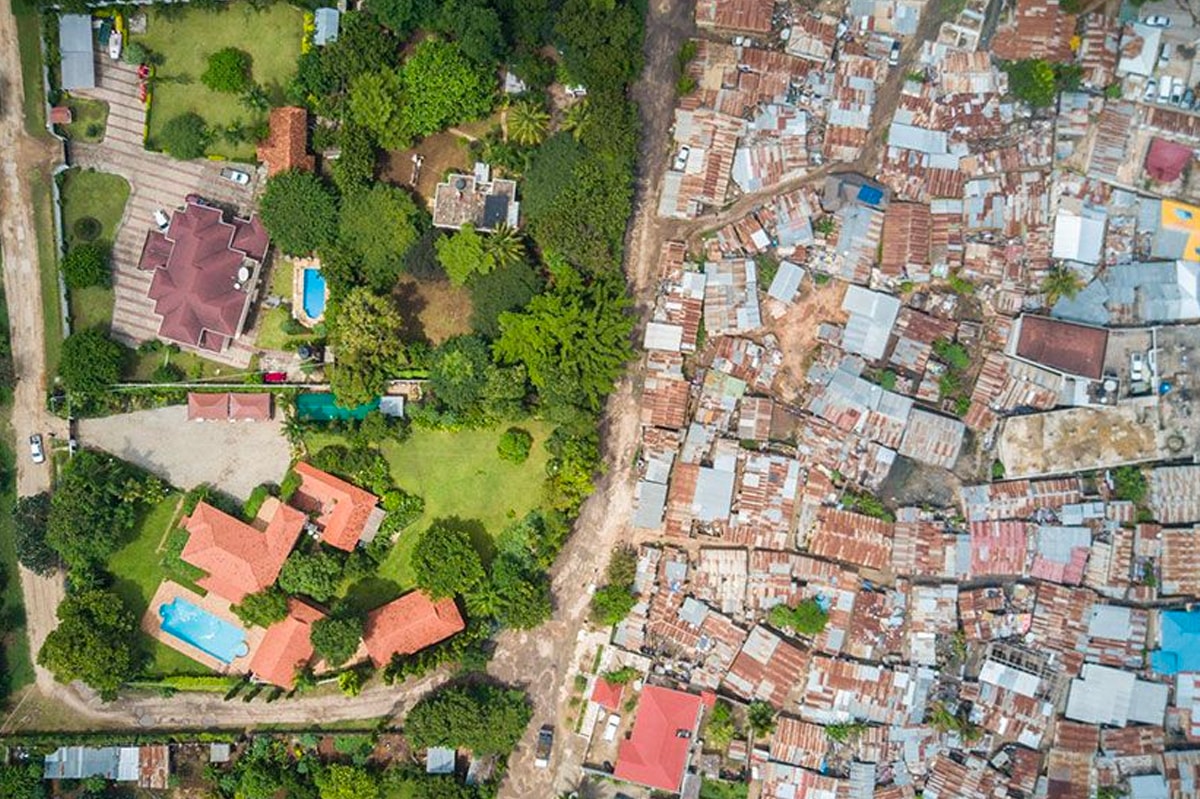
Johnny Miller is a documentary photographer based in South Africa.  His work addresses issues of human inequality including social and cultural perspectives.  His drone-photographed project Unequal Scenes depicts urban scenes from above, highlighting the stark contrast in living conditions for the rich and poor in countries such as Mexico, South Africa and the United States. Using a single image to depict the close proximity in which extreme poverty is placed to the privileged few is a shocking reminder of the unequal distribution of wealth in global society.


Mexico City                                                   Vukuzenzele


Johnny Miller 'Unequal Scenes' Drone Photography   Johnny Miller 'Unequal Scenes' Drone Photography

Nairobi                                                           Tanzania


References:

http://www.dougiewallace.com [Accessed 4 January 2020]

unequalscenes.com [Accessed 4 January 2020]

http://www.millefoto.com [Accessed 4 January 2020]

http://www.lensculture.com/millejoh [Accessed 4 January 2020]


Exercise 1.2: Photography in the Museum or in the Gallery?

In her essay Photography’s discursive Spaces: Landscape/View Rosalind Krauss discusses whether we are creating a ‘false history’ by placing photographic works that were intended as a scientific record, rather than an aesthetic piece, on a gallery wall.  Topographical photographs were ‘originally undertaken for purposes of exploration, expedition and survey’.

Peter Galassi, who organised the Museum of Modern Art exhibition Before Photography exploring the influence of painting upon early photography, argued that even photographs created for scientific purposes follow the aesthetic trends set by eighteenth century landscape paintings, such as the tendency to flatten perspective and thus such images cannot be categorised as purely technical but also contain an aesthetic and artistic element.

However, Krauss argues that works such as those by Timothy O’Sullivan were only widely viewed via a stereoscope which gives the viewer a unique viewing experience where the eye takes in each plane of perspective, adjusting and refocusing as it moves from one plane to the next.  This sense of depth was often deliberately emphasised by the photographic composition and, indeed, O’Sullivan’s work often made use of such compositional aspects as positioning a marker in the fore- or middle ground to ‘center’ the space.

Furthermore, most scientific photographers referred to their works as ‘views’ rather than ‘landscapes’.  Further evidence of the lack of artistic individuality can be found in the copyright for these images which was attributed to publishing houses rather than the photographer.  Along with the common storage of ‘views’ within ordered filing cabinets, there is a distinctly different discourse to that of the exhibition space.

Another example of a photographer of records is August Salzmann.  Can we apply the term ‘artist’ to and speak of the photographic ‘career’ of someone whose entire photographic output was generated in less than a year?  And can we apply to his work the term ‘oeuvre’, which assumes a sustained effort over a long period of time to create a coherent body of work, when it consists of one volume of archaeological photographs, some of which are known to have been taken by his assistant?

I think Krauss’ argument is a compelling one, and that we should be careful when looking at images that as far as possible we are aware of the photographers’ original intentions to avoid ignorantly applying inaccurate contemporary ideals and assumptions.  However, I do not think this means we should only view works within their original discourse, after all appropriation of images and objects is common in the modern age and has been in practice since Marcel Duchamp’s ‘found objects’ were displayed in the exhibition space.  Applied knowingly, it can stimulate intelligent debate about what constitutes art and the meanings behind placing ‘non-art’ objects and artefacts within the gallery space.

References:

Krauss, R. (1982) ‘Photography’s discursive spaces: Landscape/view’ In: Art Journal, 42(4), pp. 311-319

Exercise 1.1: Preconceptions

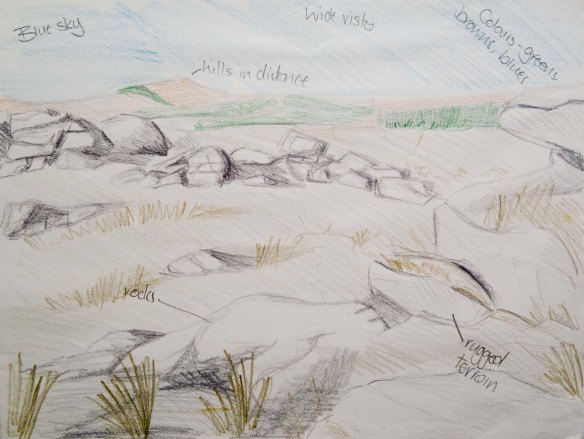
This first exercise asks us to draw a rough sketch of a landscape, to assess our preconceptions about the genre.

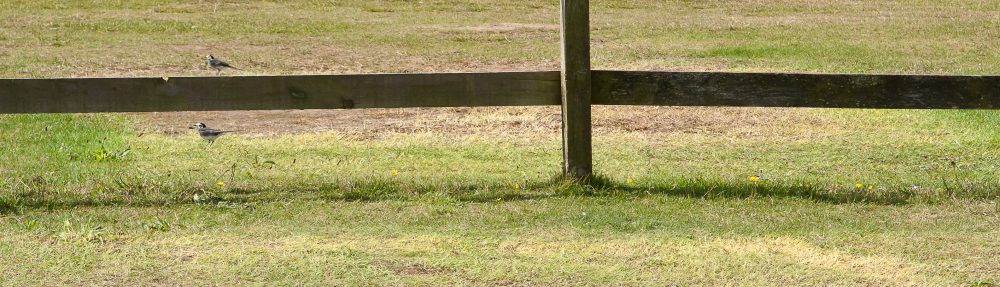
Landscape sketch

Although I am aware that a landscape is not necessarily a pretty image of the countryside, it was nevertheless Dartmoor that immediately came to mind when I initially started thinking about what landscape means to me, perhaps understandably as I do live only a short drive away.  Interestingly, however, I actually live nearer to the sea but didn’t consider a seascape until I had been thinking for some time about different types of landscape, after cityscapes and urban detail images amongst others.  I suspect the countryside image springs to mind first because the concept of landscape is inextricably linked with the history of painting, and those early definitions by the likes of Claud Lorrain and Nicolas Poussin depicting pastoral idylls are embedded deeper into our minds than we realise.  Indeed, the Wikipedia entry for ‘Landscape Painting’ describes ‘natural scenery such as mountains, valleys, trees, rivers and forests’ but makes no mention of seascapes.

Thus far, my instinctive concept of a landscape seems fairly traditional.  My sketch contains some of the typical elements of those seventeenth century genre-defining works such as the wide vista and front to back depth with hills in the distance, and is in the traditional landscape format with the long side of the paper on the horizontal.  I also included a glorious blue sky.  However, the wild beauty of Dartmoor calls for a more rugged approach than some of the more dreamy Romantic landscapes, even though many artists have painted it in this style, and my sketch contains jagged rocks and coarse tufts of grass.  I also allowed it to be a pure view of the land with no people or man-made structures and thus have deliberately left an absence of narrative.

References:

https://en.wikipedia.org/wiki/Landscape_painting [accessed 16 June 2019]