

Assignment Two: A Journey

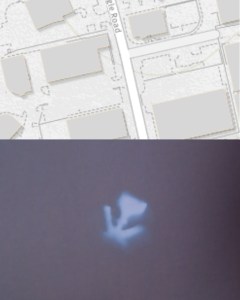
For this assignment I made several walks in the industrial estate around where I work. These are familiar routes for me as I walk for exercise every lunchtime.  The area is a contrast of expensive glass-fronted buildings with armies of gardeners working with military precision and older, shabbier, buildings, ‘bastard children of the tractor shed’ as coined by Farley and Symmons in their book Edgelands.  I usually see the same people on a daily basis; mostly lone men in smart business attire and groups of men in high visibility work jackets, plus the occasional dog walker on an extended trek from the local housing estate.

It was whilst reading Edgelands and carrying out the exercise to explore a road that I started thinking of the typicalities of certain man-made landscapes; I have never visited any of the places in the book but I know what they look like because every town has them.  I started thinking about human behaviour within and effects upon the landscape and as I walked, I considered the litter that seems to be left almost everywhere and began to wonder whether we can tell something about the landscape by the litter we find there.  For example, would objects discarded in the street on an industrial estate be the same as those dropped in a town centre or housing estate?

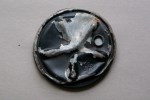
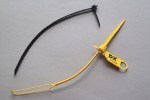
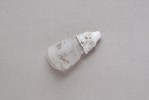
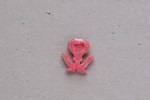
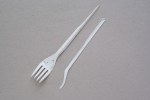
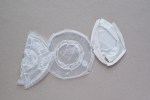
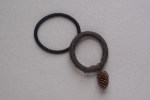
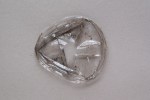
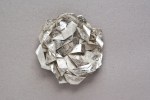
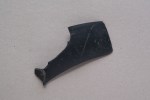
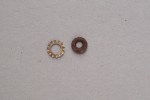
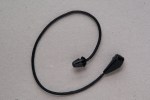
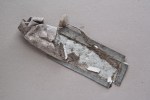
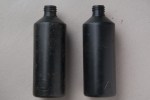
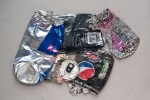
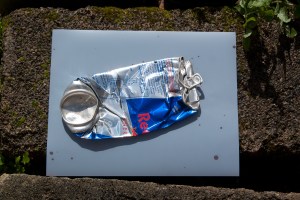
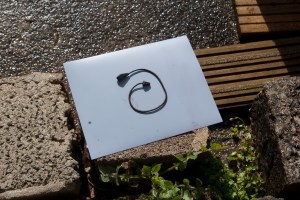
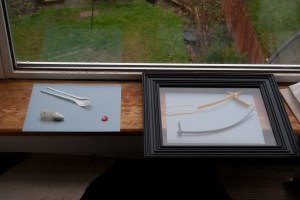
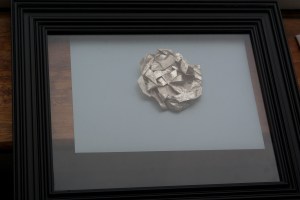
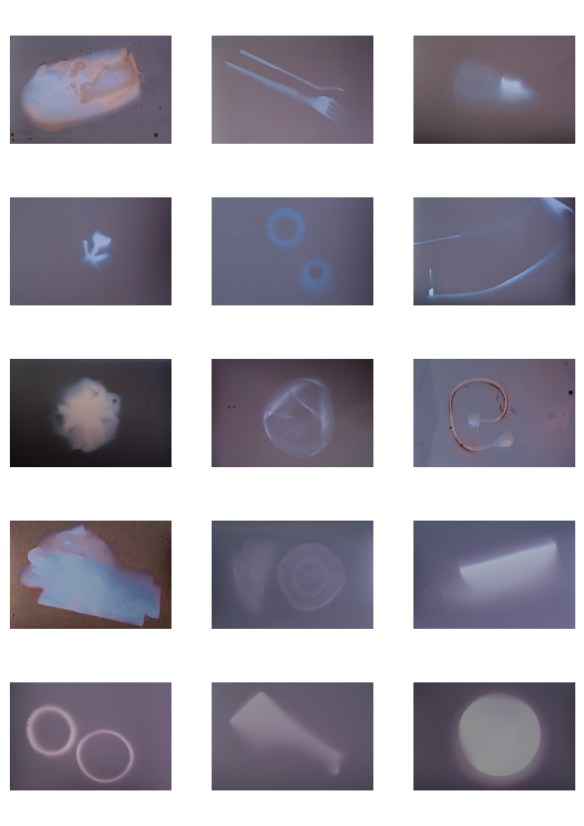
In keeping with my idea of categorising litter by the area where it was collected, as I brought pieces home I photographed them in a catalogue style: all from the same overhead viewpoint; positioned on a plain grey background; and all collated with objects of the same type.  This typological approach was inspired by the 1980 series Water Towers by Bernd and Hilla Becher which was part of the Topographics exhibition.  The resulting images make an interesting set as they are and I considered submitting them in that form but wanted to develop the series further to see where it could progress.

Artists like Naomi White have considered the effects of humans on our environment by making litter into art and her series Time Capsules from the Anthropocene uses discarded plastic objects such as carrier bags to warn of the dangers of of our throwaway lifestyle. I like White’s practice of removing the litter from its resting place and using it as part of an image created in a separate setting.  However, I wanted my litter to tell the story of its landscape much as Richard Wentworth’s discarded and repurposed objects tell a story about  human behaviour.

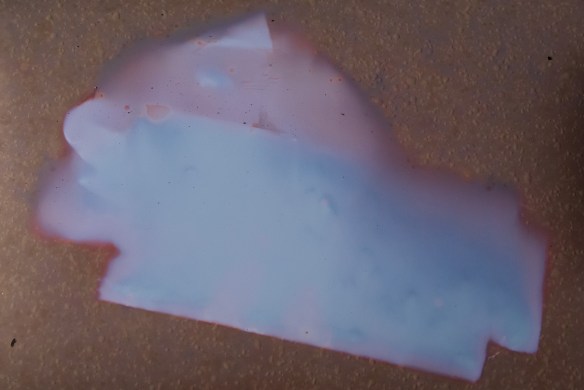
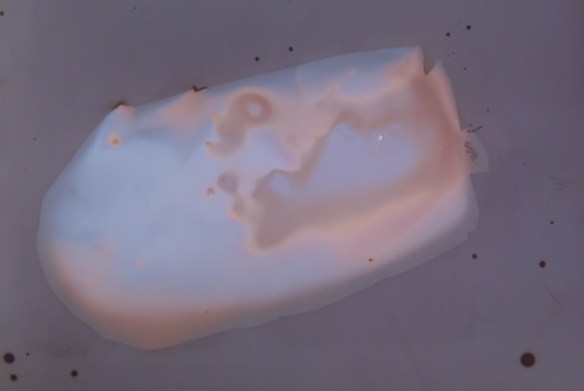
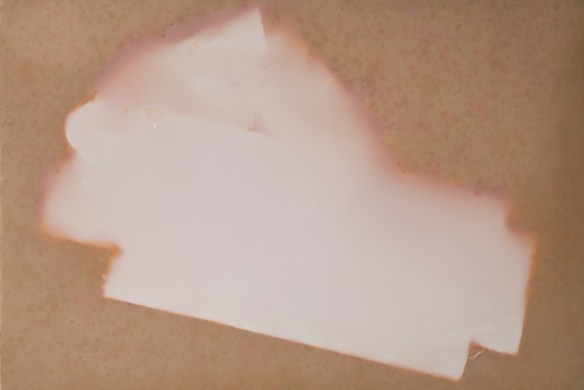
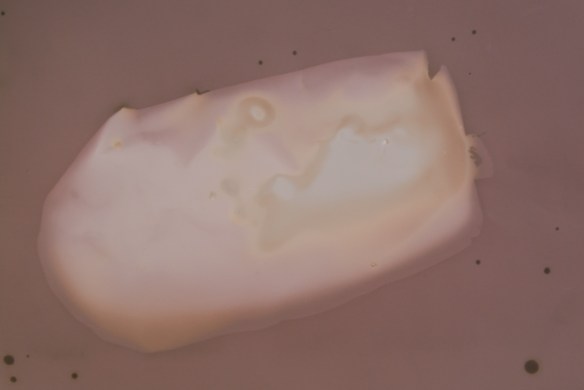
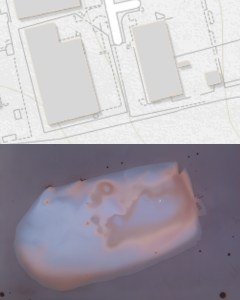
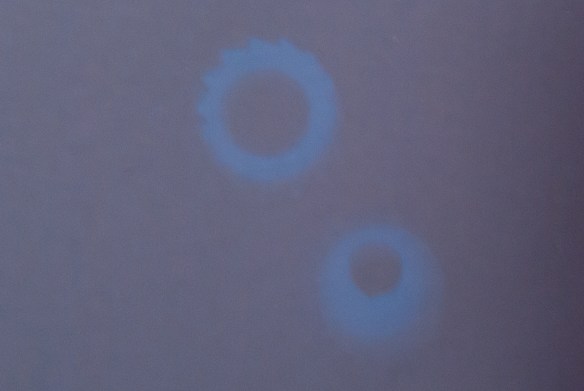
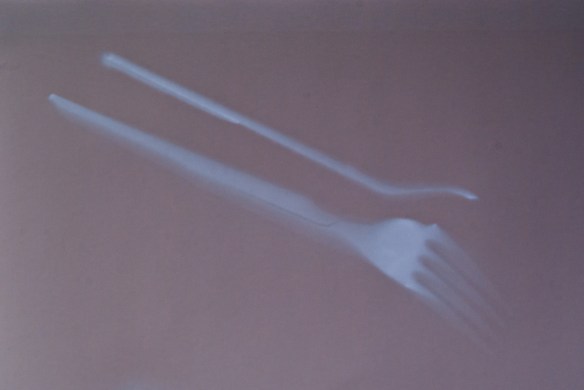
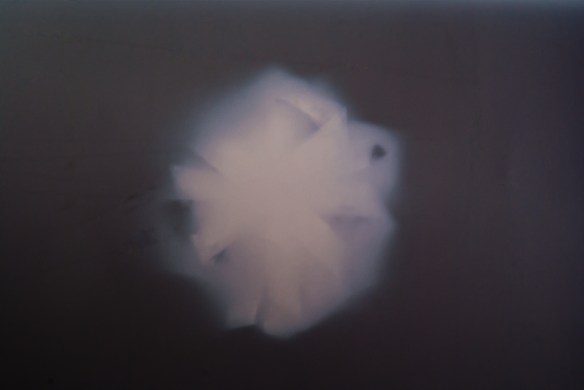
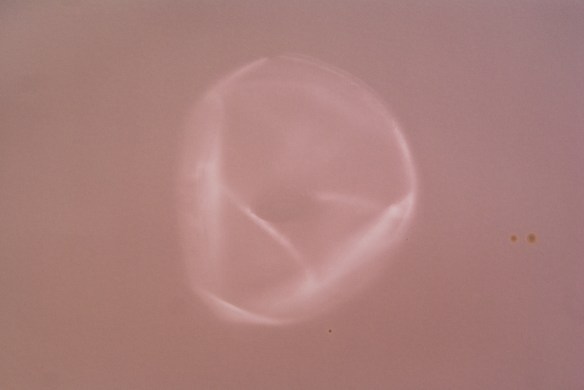
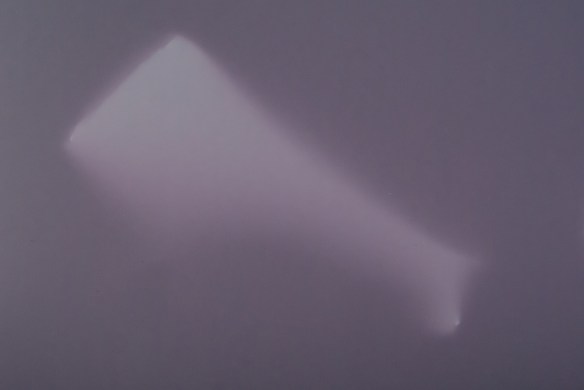
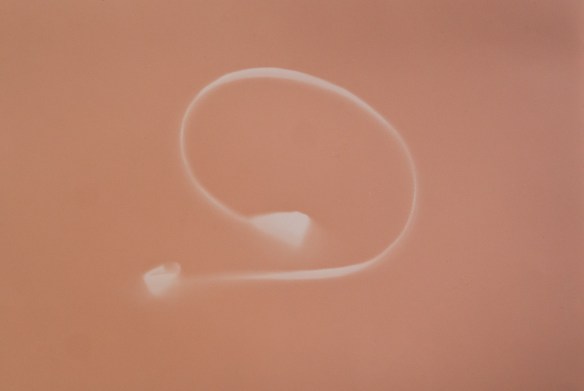
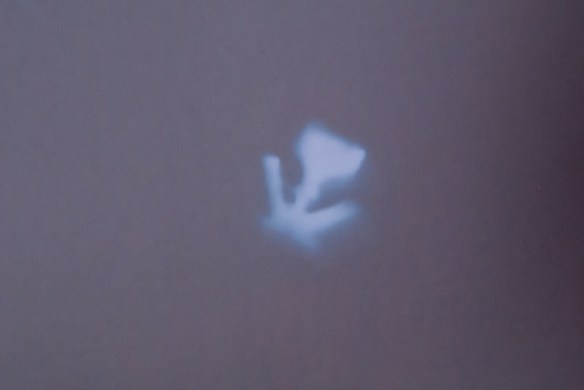
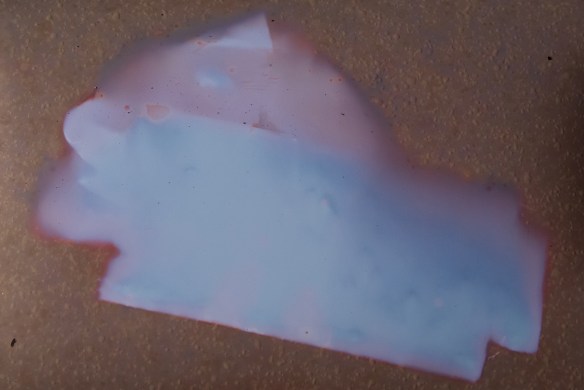
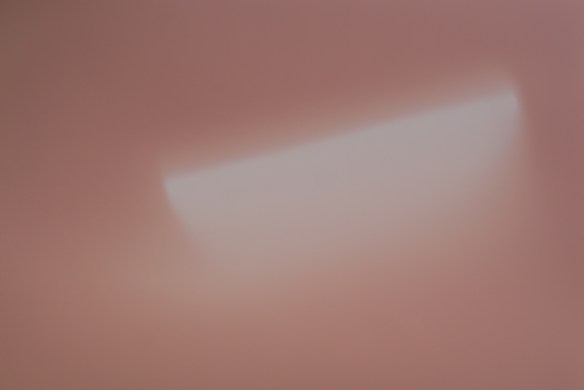
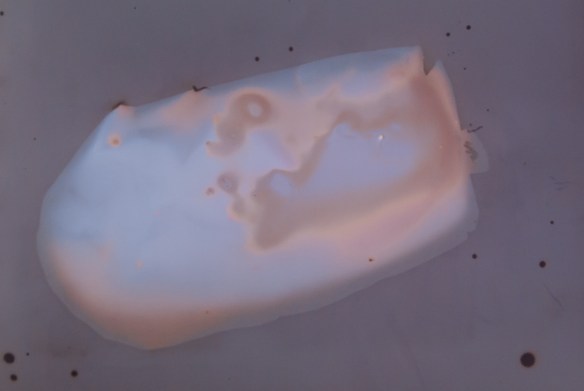
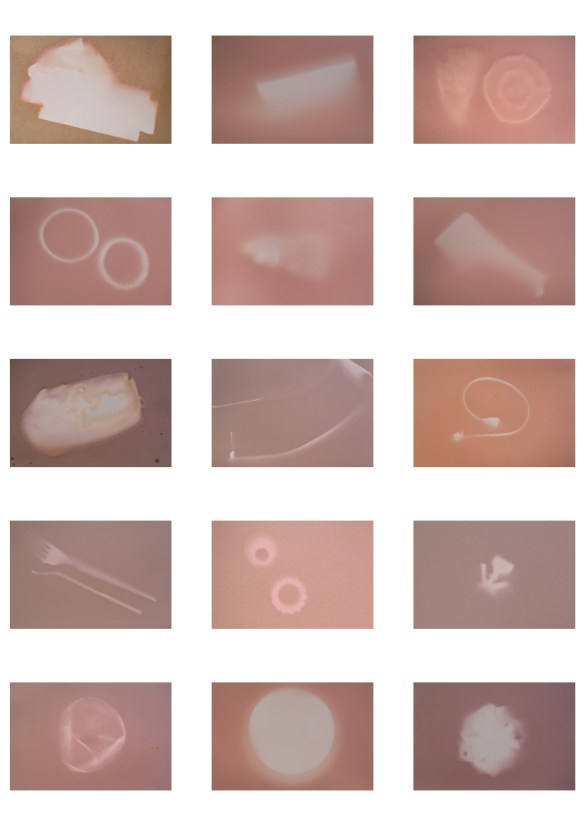
I noticed a marked difference in the physical deterioration of the objects that had clearly been discarded some time ago.  They had been ravaged by the light and weather compared with newer items which looked as though they had been dropped only days or even hours before.  This effect of the outdoor environment on the physical condition of the objects led to my idea of making lumen prints with them.  The act of directly using sunlight to create the images reflects the physical changes manifested on the objects themselves by their exposure to the environment and is also a natural progression on from the cyanotype process I used for Assignment One.

I am pleased with the result of this project as I set out to ask a question about location, that is what the litter found in that location can tell us about the landscape.  The items found were clearly directly related to the industrial estate and displayed on their own create a thread to the landscape that the viewer can follow.  My intention would be for this to be the first part of a series looking at different environments and the different types of discarded objects that can be found there.

References:

Farley, P. and Symmons Roberts, M. (2011) Edgelands Journeys into England’s True Wilderness. Rochester: Vintage Digital

www.tate.org.uk/art/artworks/bernd-becher-and-hilla-becher-water-towers-p81238 [Accessed 20 April 2020]

www.naomiwhite.com [Accessed 23 April 2020]

www.lissongallery.com/artists/richard-wentworth [Accessed 23 April 2020]

Bright, S. (2005) Art Photography Now. London: Thames and Hudson


Assignment One: Tutor Feedback and Response

I am very pleased with the feedback I received from my tutor for Assignment One.  My tutor said I write very well and am able to communicate my ideas, influences and creative ambitions.

The cyanotype colour works well as an emotive aid, evoking a sense of melancholy and turning everyday landscape scenes into something uncertain.  It also adds drama to the optical distortion and diffusion created in the cyanotype process which in turn adds to the sense of the uncanny and uncertainty.   The black graphics disturb the notion of the photograph depicting something that was once in front of the camera as well as offering a psychological gateway.

I am pleased to have achieved a balance between descriptive and analytical writing as feedback from previous modules has indicated that my content is a little light on the analytical aspect and this is something I have been consciously working on in response.

I have a list of follow up actions to work through:

  • Include details of the creative process leading to submitted assignments
  • Develop this assignment further by making physical cuts in the cyanotype prints rather than adding the black shapes digitally (due to time constraints I will carry this out at the end of the module prior to assessment)
  • Investigate Ackroyd and Harvey who developed grass seed that could retain photographic impressions for a long time.  I have heard of this before and I have an idea surrounding grass for a later assignment so this will be useful research
  • Look at Freund’s paper on the uncanny with a view to developing assignment one further
  • Look at John Balldessari’s work using coloured dots
  • Tidy up missing references and spelling in my learning log.  I have started to go through this and it is part of my standard workflow prior to assessment so I will continue to read back through previous submissions and amend as required.

Assignment Two: Preparation and Set Up

For Assignment Two, I have been walking around the industrial estates where I work, collecting items of litter I found.  In response to the exercise on typologies I ordered the items into sub-groups and photographed them on a sheet of plain grey paper, as a way of cataloguing my finds.  I wanted to know if the type of litter found in a certain landscape is reflective of the surrounding human environment.  The project could be presented as it is alongside collections resulting from walks in different areas.


I pursued the idea of sunlight affecting the items by producing lumen prints of the objects positioned in a similar way to the above on sheets of photographic paper and left to develop in the light.  This was the first time I had experimented with the creation of lumen prints.  Where possible, I laid a glass frame on the item to flatten it and create a more defined outline.  The weather was changeable while I was making the prints so some were laid on a windowsill indoors rather than outside.

I found that the images produced outside contained a greater range of colours and rain produced an interesting effect that could be explored further for future projects.

However, the effect was lost somewhat once the images were fixed and the colour balance changed.


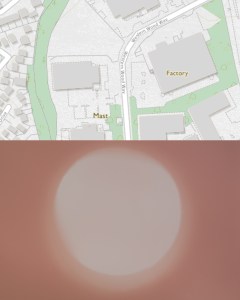
Finally, in progression of my original idea of whether different litter is dropped in different landscapes, I experimented with the idea of incorporating maps into the project, an idea I later rejected as I felt the lumen print images were effective on their own.


Exercise 2.6: Edgelands

Michael Symmons Roberts and Paul Farley’s book Edgelands reads like a poem with its lyrical prose dedicated to the oft-forgotten spaces between the urban sprawl of our cities and the chocolate box prettiness of the countryside.

For this exercise I read the chapters Wire and Power about fences and power stations respectively and I have previously read some of the other chapters.  From Wire the following extract stood out for me:

Variations on the theme of the fence include rows of upstanding spears tilted at the top to point outwards at potential climbers, plus the alternative toppings of barbed wire or razor wire.

Coils of barbed wire, like a well-trained bramble coiled along the top of a fence, are threatening enough, but razor wire takes latent violence to a new level.  Kids at school who carried razor blades were unhinged, off-the-scale, unpredictable.

This extract is typical of the way the book examines the ‘eyesores’ of the outskirts of cities, the areas that many of us bypass without a thought, and relate them to human experience.  This is often the experience of youth; of ordinary working class children and teenagers who play in the street, the type who are themselves often overlooked by society.

There is a gentle beauty in the discussion of both forgotten landscapes and overlooked youth, in the way the book invites contemplation of areas we never usually think of yet turn out to be fascinating in their unique banality.

References:

Farley, P. and Symmons Roberts, M. (2011) Edgelands Journeys into England’s True Wilderness.  Rochester: Vintage Digital


Research: Richard Wentworth

Richard Wentworth has been a pioneer of New British Sculpture since the late 1970s.  His interest lies in the items we use every day, using found objects, often in unusual juxtapositions, to create his sculptures.

He has always used photography as an observation tool but only started to exhibit those images in the mid-1980s.  I find this interesting as putting them into the gallery space has changed their context; the addition of an external viewer has altered the discourse from personal note to art and raises the question of whether art without a viewer can be considered art at all.

Wentworth’s photography work takes in the detritus of human existence: the result of mundane acts carried out; repurposed and abandoned objects.  As he explains “…what is a television that is sitting on the roadside miles away from an electricity supply?  Is it still a television?  It’s something to do with being dead yet alive.  It’s the small human acts that reach out to my way of seeing.”

Incorporating humour and a sense of the bizarre, Wentworth uses his sculptor’s eye to spot the geometries and quirkiness within found scenarios and uses them to raise questions in the viewer’s mind about the minute human acts that would otherwise have gone unnoticed.

Susan Bright- Art Photography Now | Contemporary art photography ...

Genoa, Italy, 2004


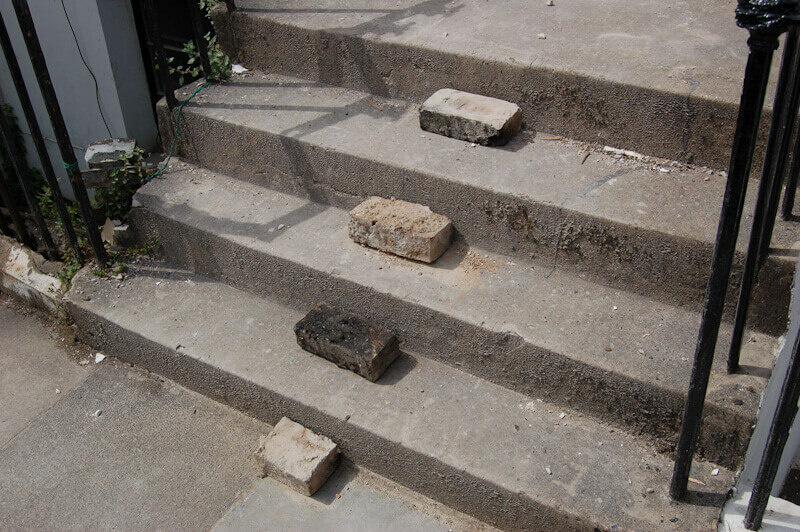
Caledonian Road, London, 2007

Caledonian Road, London, 2007

References:

www.lissongallery.com/artists/richard-wentworth [Accessed 12 April 2020]

Bright, S. (2005) Art Photography Now. London: Thames and Hudson
 

Research: Naomi White

Naomi White is a Los Angeles-based photographer whose work addresses themes such as feminism, consumerism and ecology.

Her series Time Capsules from the Anthropocene juxtaposes objects and scenes from nature with elements of the man made world, presented as still life compositions in a nod to seventeenth century Dutch still life paintings.  Like the vanitas, her works use animal skulls as a symbol of mortality, alongside other signifiers of nature such as flowers and photographs of picturesque landscapes.  Placed next to symbols of modern consumerism, such as plastic bags and wash baskets, we are reminded of the impact humans are having on our natural world and of the delicate balance as we find ourselves at the tipping point of irreversibly devastating our planet’s natural ecosystem.

Time Capsules from the Anthropocene - Naomi White Photography

In her series Plastic Currents, she investigates the form of the plastic bag.  Used to carry our purchases, the carrier bag is a symbol of our consumerist greed, and therefore of capitalism.  In White’s work, the bag is no longer a cheap throwaway object in which to transport the material objects we seem to be unable to stop buying in vast quantities, but becomes the material object itself, taking on a new form of undulating, flowing form, appearing almost organic.


Plastic Currents - Naomi White Photography

References:

www.naomiwhite.com  [Accessed 5 April 2020]