This exercise asks us to find twelve examples of eighteenth- and nineteenth-century landscape paintings.
Until the seventeenth century, landscapes in painting existed as purely background for portraits or paintings depicting mythological or religious themes. During the seventeenth century, artists such as Nicolas Poussin and Claude Lorrain began to create works that gave more emphasis to the landscape and sought to depict a classical Greek idyll.
Jean-Antoine Watteau – The Festival of Love (1718-1719)
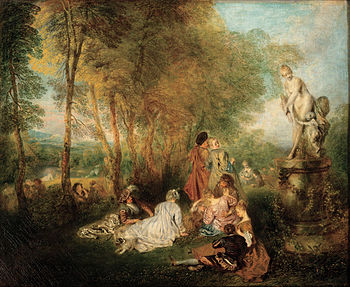
Painted in the Rococo style, Watteau’s work is an example of one of his fêtes galantes; fantasy pieces often inspired by the Italian theatre that depict men and women in elegant costume, often in parkland, in an idyllic, whimsical settings. In 1712 Watteau was accepted as an associate member of the Royal Academy of Painting and Sculpture and in 1715 he took up a post as live in artist at the Montmorency residence of very wealthy financier Pierre Crozat. Here he was able to paint the surrounding gardens and countryside.
François Boucher – Landscape with a Watermill (1755)
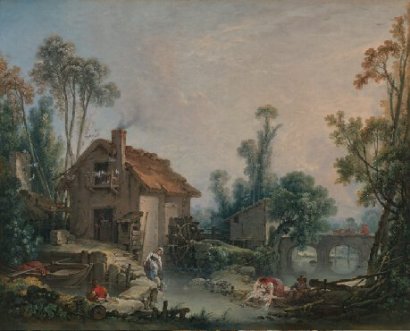
Boucher’s Watermill is a highly idealised depiction, probably of the watermill at Quinquengrogne on the outskirts of Paris. His chief patron was Madame de Pompadour, the king’s mistress, until her death in 1764, and in 1765 he was appointed first painter to the king.
Jean-Honoré Fragonard – Landscape with Shepherds and Flock of Sheep (c.1763)

Fragonard followed in the style of Watteau with his charming scenes. However, in contrast to Watteau’s painting above, Landscape with Shepherds and Flock of Sheep places much less emphasis in the figures. His patrons were largely members of the court of Louis XV; as most of them were either guillotined or exiled during the French Revolution Fragonard lost favour for his work and died in obscurity in 1806.
Thomas Gainsborough – Wooded Landscape with a Peasant Resting (c.1747)
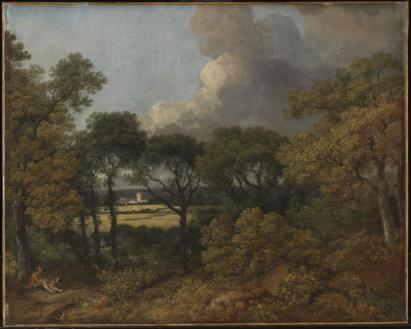
Wooded Landscape with a Peasant Resting was painted when Gainsborough was about twenty, during his apprenticeship in London. During his early years, Gainsborough was primarily known as a landscape painter, with his works showing influences from both Dutch work and the Rococo movement.
Richard Wilson – Landscape with Bathers, Cattle and Ruin c. 1770-5
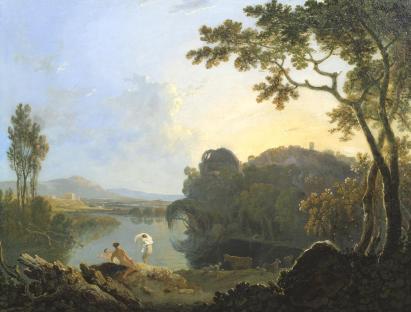
Wilson was a Welsh painter who stayed in Italy during the 1950s where he observed the landscapes and developed a classical style. Following his return to Britain in 1757, he took commissions from patrons who wanted their own estates painted in the Italian style, as well as continuing to paint imagined Italian scenes.
John Constable – The White Horse 1819
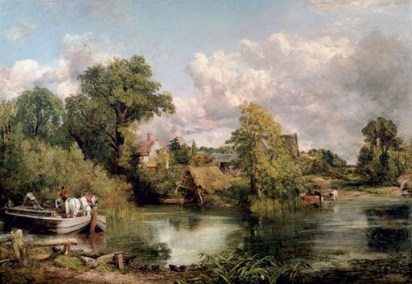
This painting, known as one of Constable’s ‘six-footers’ because of its large size, was initially exhibited at the Royal Academy in 1819. Constable embarked on this new size of painting to establish himself as a professional in order to support his family and this work was instrumental in his election as an Associate of the Royal Academy.
Joseph Mallord William Turner – Landscape with Trees and a Castle (c.1828)
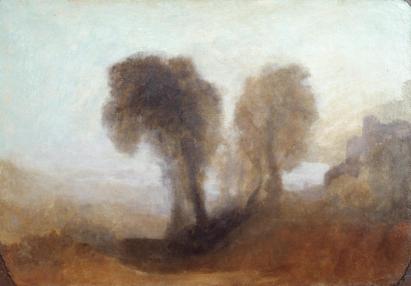
Turner visited Italy from October 1828 to January 1829; it is believed this painting was one of the works he created at this visit. Paintings from this series were exhibited during his time in Italy and it was reported that there were over a thousand visitors to see these ground-breaking works. This work, along with almost three hundred others, was donated to the nation by Turner upon his death.
Caspar David Friedrich – The Giant Mountains (1830-35)
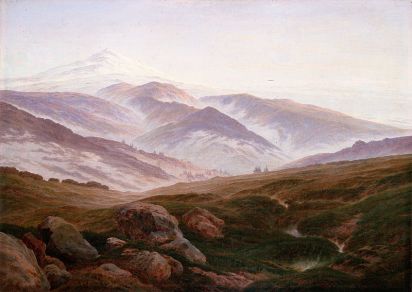
Friedrich received few commissions for his work and by the time of this work he was living as a recluse. His landscape works are great, empty vistas with a huge depth, occasionally depicting tiny human figures who are dwarfed by the enormity of their surroundings.
Jean-François Millet – Haystacks: Autumn (1873)
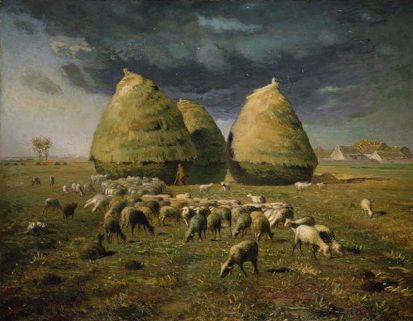
This painting is one of a series of four depicting the seasons commissioned by Frédéric Hartmann. Millet had been one of a group of painters who followed the programme of Constable in the French village of Barbizon in the late 1940s. Millet’s aim was to paint peasant life in a realistic way, rather than depicting a romantic idyll. This painting depicts a scene after the harvest when the gleaners have finished and the sheep have been left to graze.
Claude Monet – Impression, Sunrise (1872)
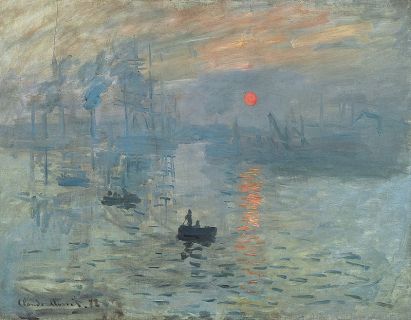
Monet urged his fellow Impressionists to work ‘en plein air’, ie to paint outside in front of the view they were painting, and not to paint a single stroke in a studio. Such conditions necessitate a certain technique, for under changing conditions it is essential to work quickly, thus giving little in terms of intricate detail but providing an overall effect. In 1874, after continual rejections by the Paris Salon, Monet and around 35 other artists held their own exhibition, to outrage and derision from visitors.
Paul Cézanne – Montagne Sainte-Victoire with Large Pine, (1887)

Cézanne painted various perspectives of Mont-Sainte Victoire between 1882 and 1906. Although in his youth he exhibited alongside the Impressionists, in contrast to their work Cézanne painted in geometric blocks of colour, outlining forms and giving his subjects a more solid feel. He was supported financially by his father and was not dependent on selling work to make a living.
Vincent van Gogh – Landscape under a Stormy Sky (1888)
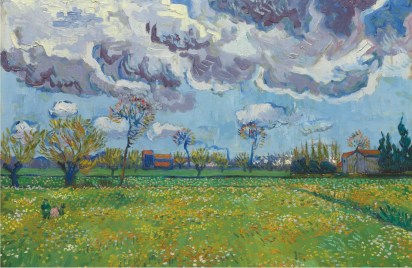
This work was painted during van Gogh’s stay in Arles, where he had travelled in search of the intense light and colour of southern France. His brother, Theo, worked in an art-dealer’s and had financed his trip to Arles. Vincent hoped to repay him by providing him with saleable artworks.
Looking at these paintings and also my own sketch drawn for the first exercise, there are several factors that feature again and again. Firstly, they are all in landscape format. Whilst researching for paintings to include in this post I did come across two that were in portrait format, but they were by far in the minority. They all feature the sky in some way, usually with clouds, most more dramatic than the cotton wool versions I portrayed in my sketch. They all convey a sense of depth, most with a large front to back distance. People feature only as a small part of the overall composition, if at all.
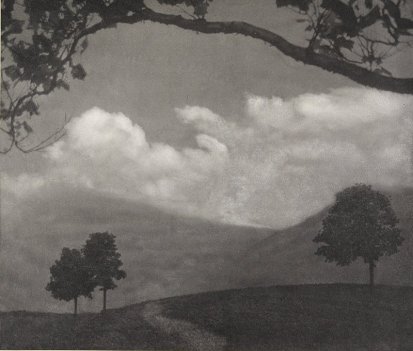
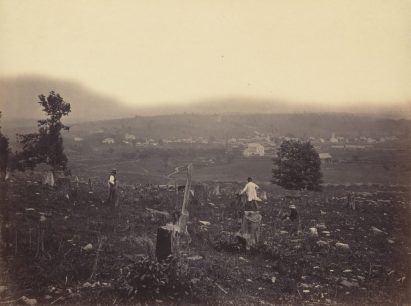
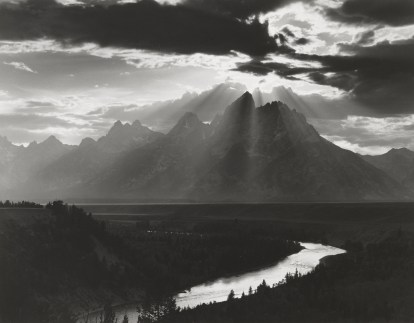
Some examples of photographic works that are influenced by the styles of landscape discussed above are shown below.
Wilbur Porterfield – The Way to the Valley (c.1917)
Thomas Johnson – Waymart (c.1863-65)
Minor White – Grand Teton National Park, Wyoming (1959)
References:
https://en.wikipedia.org/wiki/Jean-Antoine_Watteau [accessed 12 July 2019]
https://prabook.com/web/jean-antoine.watteau/3725112 [accessed 12 July 2019]
https://kids.kiddle.co/Jean-Honoré_Fragonard [accessed 12 July 2019]
https://en.wikipedia.org/wiki/Jean-Honoré_Fragonard [accessed 12 July 2019]
https://www.tate.org.uk/art/artworks/gainsborough-wooded-landscape-with-a-peasant-resting-n01283 [accessed 15 July 2019]
https://www.tate.org.uk/art/artworks/wilson-landscape-with-bathers-cattle-and-ruin-n01290 [accessed 15 July 2019]
https://www.historic-uk.com/HistoryUK/HistoryofWales/Richard-Wilson-Welsh-Landscape-Painter/ [accessed 15 July 2019]
https://www.nga.gov/collection/art-object-page.1146.html [accessed 15 July 2019]
https://www.tate.org.uk/art/artworks/turner-landscape-with-trees-and-a-castle-n05528 [accessed 15 July 2019]
https://www.nationalgallery.org.uk/about-us/history/the-turner-bequest [accessed 15 July 2019]
https://www.tate.org.uk/art/art-terms/l/landscape [accessed 16 July 2019]
https://www.britannica.com/biography/John-Constable#ref5525 %5Baccessed 16 July 2019]
https://www.metmuseum.org/toah/works-of-art/60.71.12/ [accessed 16 July 2019]
https://www.claude-monet.com/impression-sunrise.jsp [accessed 16 July 2019]
Gombrich, E. H. (1984) The Story of Art (14th edition). Oxford: Phaidon Press Limited
https://collections.artsmia.org/art/12682/the-way-to-the-valley-wilbur-h-porterfield [accessed 21 July 2019]
https://noma.org/exhibitions/east-mississippi-nineteenth-century-american-landscape-photography/#exhibition-works [accessed 21 July 2019]
https://www.moma.org/collection/works/47128 [accessed 21 July 2019]
 Rhonda's Landscape blog