Research: Anselm Kiefer

Anselm Kiefer is a German painter, sculptor and photographer focusing on mixed media methods. His landscapes address themes incorporating events from German history such as the Holocaust and Nazi rule.

His work is visceral, unflinching and raw; the antithesis of the Picturesque. His paintings are almost monotone, deeply textural and semi-abstract, the identification of a landscape sometimes only possible through a positioning of lines.

The Milky Way by Anselm Kiefer, mixed media painting.
The Milky Way

Throughout his work we see evidence of destruction: churned, furrowed earth; black, billowing smoke; ruined wastelands; gritty textures; and physical deterioration of the artwork. His photographic works are sometimes from his own images, sometimes appropriated and doctored, often allowed to deteriorate almost beyond recognition. The photographs were the first of Kiefer’s works I discovered and, without knowing anything about him, I was immediately reminded of wartime landscapes, of trenches, rutted earth and destruction as well as the passage of time. It is impossible to view these images without some sort of response on a psychological level, even without knowing what they represent.

Anselm Kiefer: a beginner’s guide | Blog | Royal Academy of Arts [Accessed 28 March 2021]

Anselm Kiefer born 1945 | Tate [Accessed 28 march 2021]
Book: Shadow Catchers

This book was recommended to me by my original tutor for this course, Andrew Langford. It explores the work and practices of five artists working with camera-less photography and presents a brief history of the methods of working within this genre, from William Henry Fox Talbot to the modern day via the the likes of Man Ray and Frederick Sommer.

The techniques featured include cyanotypes, photo grams, chemical grams and dye destruction prints. What strikes me in particular about each of these methods is that the process is as much a part of the work as the finished piece itself, much like some of the other practitioners I have researched earlier in the course, particularly in Land Art. There is very much a sense of performance in the life-sized human photograms by Floris Neusüss, for instance.

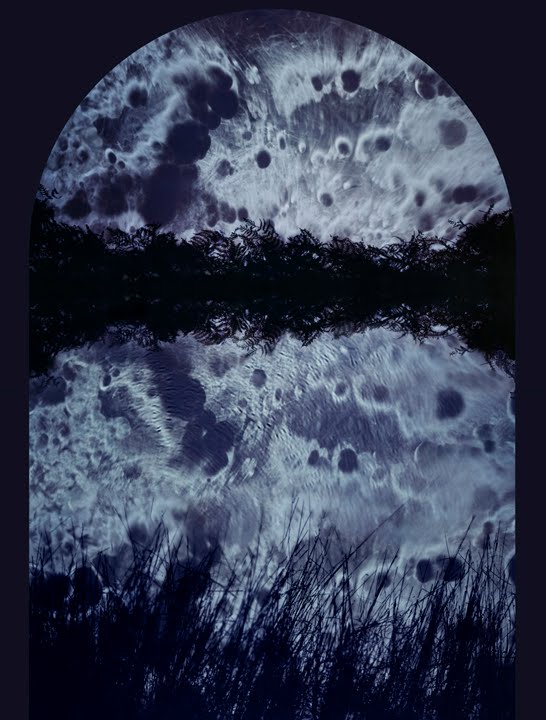
I was particularly interested in the work of Susan Derges. Based in Dartmoor, she spends time in the field and in her studio creating ethereal landscapes that feature plant photograms, images taken by placing photographic paper in the River Taw at night and creating an image with flashlight. The result is a sublime collection of landscapes that seem not quite real, but equally not completely fictional. In her series Arch, she depicts the four seasons, each framed by a black arch with a silhouetted foreground, giving the viewer the impression of looking through to a new space, like some magical secret garden.

Arch 2 (winter) 2007-08

Barnes, M. (2012) Shadow Catchers Camera-Less Photography (2nd ed.). London: Merrell Publishing

Research: Hans Haacke

Hans Haacke is a German-born artist currently residing in New York City. His work is frequently a commentary on social, political and economic systems, such as his work highlighting GENCOR’s treatment of its on strike gold and coal miners, where they were hit with tear gas, firearms and dogs, evicted from their quarters, and in many cases fired from their jobs. Haacke’s response was to create a corporate-looking display that appears to be a display from a trade show or some high profile event which, on closer inspection, depicts the affected black workers and tells their story.

He also makes commentary on the art world with work that directly references the likes of Duchamp and Magritte, particularly referencing Duchamp ‘ready-mades’. Fully aware that the ready-makes are now revered objects in their own right, Haacke also references Duchamp’s focus on the power of context and the way he upended universal assumptions.

I am particularly interested in Haacke’s work from the 1960s and early 1970s where he brought different plants into the gallery environment. I used grass as a photographic receptor for Assignment five and am considering ways in which the concept could be developed further. Haacke was interested in plants as a way of exploring unregulated growth and in how artworks can evolve and grow naturally. The work is allowed to grow its own way independent of the artist and gives the art a random, constantly shifting factor, thus marking the passage of time. This is an area that appeals to me and is something I would like to explore in my future work.

In this installation view from the exhibit “Hans Haacke 1967,’’ a balloon floats in place, held by gravity and a jet of air, and the cone is a mound of growing grass.

Hans Haacke 1967 exhibition at MIT

The heyday of Hans Haacke – The Boston Globe [Accewssed 15th March 2021]

Grasskamp, W. Nesbit, M. Bird, J (2004) Hans Haacke. New York: Phaidon

Liz Wells: Land Matters

This is one of the books on the recommended reading list for the course and was an engaging and interesting read. There are many points to take away from this book and I am sure I will return to it as I progress with my studies.

I found her discussion on space and place particularly thought provoking, and the concept of landscape resulting from human action is one I hadn’t previously considered. She says that ‘Assumptions may …. be made about social uses of designed places (parks, gardens, picnic spots…). Plans are predicated on imagining types of land use, landscape and social environment that might be constructed. Whether industrial, agricultural or domestic, urban, suburban or rural, space is (trans-)formed into place through such interventions.’ This is interesting to me when considering the caravan park which was the subject of my Assignment five,/especially as this is a very specific space which has a unique pre-determined purpose.

Wells herself directly discusses the places we holiday: ‘Current emphasis on rural ‘boutique’ hotels, country cottage holidays, caravan parks and campsites, as well as the expanding network of Center Parcs, testifies to a continuation of a pastoral idyll.’ Like Wells, living in Devon, I see examples of this idealisation frequently, most recently in a company selling coastal air in a bottle for £75 (and labelling it Cornish when it is actually from Devon, Cornwall presumably being more marketable).

Wells steers away from the photographic canon to include lesser known practitioners, including a chapter on Scandinavia, and also includes Land Art as within the photographic remit which I found relevant to my critical essay. Overall, I found this a very worthwhile read that will no doubt continue to be relevant as I move onto Level 3.