Exercise 3.5: Local History

Plymouth is a city rich in history, and it is impossible to live here without absorbing some of the many famous stories whilst noticing where the past overlaps with the present day city.  This year marks the 400th anniversary of the Mayflower sailings of the pilgrims from Plymouth to America and many events were planned across the city, including the much anticipated opening of a new art gallery and the installation of an Antony Gormley sculpture on the seafront, all of which have been put on hold due to the COVID 19 pandemic lockdown.

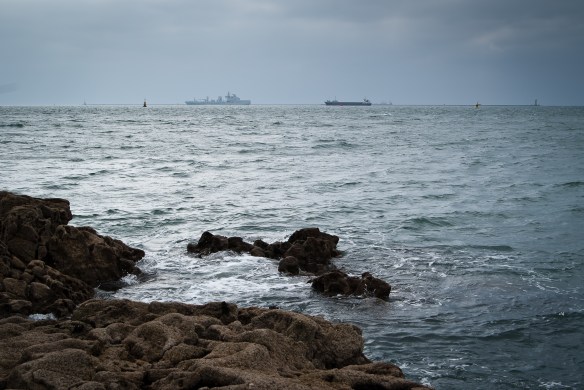
However, although I have resided here for over two decades and have heard many of the famous stories, it was not until recently that I learned of Napoleon Bonaparte’s brief stay as a prisoner of war in Plymouth Sound.
DSC07903

Having surrendered a few days before in South-West France, Napoleon had planned to flee to the United States before his imprisonment.  Brought to Plymouth aboard the Bellerophon, Napoleon was not allowed ashore and no-one but authorised personnel were permitted to board.  News had reached the mainland of the famed folk hero’s presence and people travelled from as far as Glasgow to catch a glimpse of Napoleon.  Plymouth was crammed with visitors.  Boat trips were organised into the Sound and spectators took to the water in their thousands.  Napoleon played to the attention, taking to walking the deck at around 6pm daily for the benefit of the sightseers.
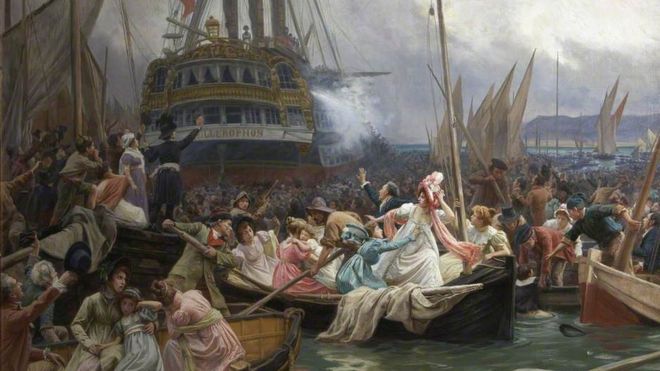
Napoleon in Plymouth Sound, August 1815 (Napoleon on Board the Bellerophon at Plymouth)

Napoleon in Plymouth Sound, August 1818 –  Jules Girardet

Such was the chaos that boats inevitably collided and lives were lost, including that of John Boynes, a local stonemason, who boat capsized in the commotion.  His wife and three children were saved but he drowned.  His headstone remains in a Plymouth cemetary.

The headstone of John Boynes who died in the Sound

Image from Plymouth Herald, reference below

I think this story demonstrates well how the most interesting parts of history are the stories about people and were I to create a piece of art inspired by this particular story it would focus on the relationship between the sea and people at all levels of society from the celebrated to the lowly.

References:

https://www.bbc.co.uk/news/uk-england-34342061 [accessed 7 June 2020]

https://www.waterlooassociation.org.uk/2018/09/11/napoleon-at-plymouth/ [accessed 7 June 2020]

https://www.plymouthherald.co.uk/news/history/dark-story-behind-plymouths-forgotten-4110018 [accessed 7 June 2020]

Exercise 3.4 – A Persuasive Image

British photographer Paul Graham’s series American Nights highlights ‘social fracture’ in a genre-defying part-portrait, part-landscape, part-documentary portrayal of the imbalance in American society.

Forty-six of the images are washed-out, almost white images depicting African-Americans, solitary figures set in drab urban landscapes, barely visible in their faded worlds.  The figures are wandering or waiting in wide, empty concrete vistas, and to me it seems that their lack of purpose is a signifier of their lives; waiting to be noticed, to be included, in society.

In ten images, African-Americans, some physically disabled, are depicted in a low-key, underexposed manner.  The backgrounds signify inner city or poorer neighbourhoods: boarded up shops; graffiti; queuing traffic.  These images perpetuate the clichés around photographing the underprivileged: urban; poor; black; underexposed; shadowy.  In choosing to adopt this stereotype in juxtaposition with the faded images, Graham is challenging the viewer’s own ingrained assumptions about the marginalised in society.

A further seven images show large, middle class suburban houses with wide driveways and leafy plots.  All are fully saturated, with bright blue skies.  We are not given any details of the affluent occupants of these dwellings, but the assumption is that there is a  contrast following the differences in the physical appearance of the images and in the affluence versus the poverty, and thus they are white.

Thus Graham uses the saturation levels of his images to tell of the differences between the haves and have nots, rich and poor, black and white.  African-Americans are shown so faded as to be almost invisible or shadowy, defined by gritty poverty.  Against these depictions, the houses of the affluent stand out garishly, their wealthy gaudy and tasteless, ostentatious in their saturation.  The series is also a demonstration of how landscape photography can be blurred with portraiture to make comment on aspects of human society.

An issue that I would like to make an image about would be food miles and provenance.  I have been always been fascinated when travelling overseas with how different other countries look from the air even in Continental Europe the vegetation and colour of  the ground can be quite contrastive to our own.  Now we have Google Earth we can readily view this even more extensively.  My idea would be to spend some time researching the origin of different food, particularly fruit and vegetables, and produce some images by photomontage or layering of the kind of environment that food was grown in.  In the UK if we imagine where our food is grown at all it would be an idealised pastoral view of idyllic fields and orchards and I think that showing an entirely different type of landscape would encourage people to think about their food in a way that glancing at the name of a country on a food label perhaps does not.

References:

https://www.paulgrahamarchive.com/americannight.html [accessed 1 June 2020]

Bright, S. (2005) Art Photography Now. London: Thames and Hudson

https://www.tate.org.uk/art/artists/paul-graham-2337/blinding-white [accesses 1 June 2020]