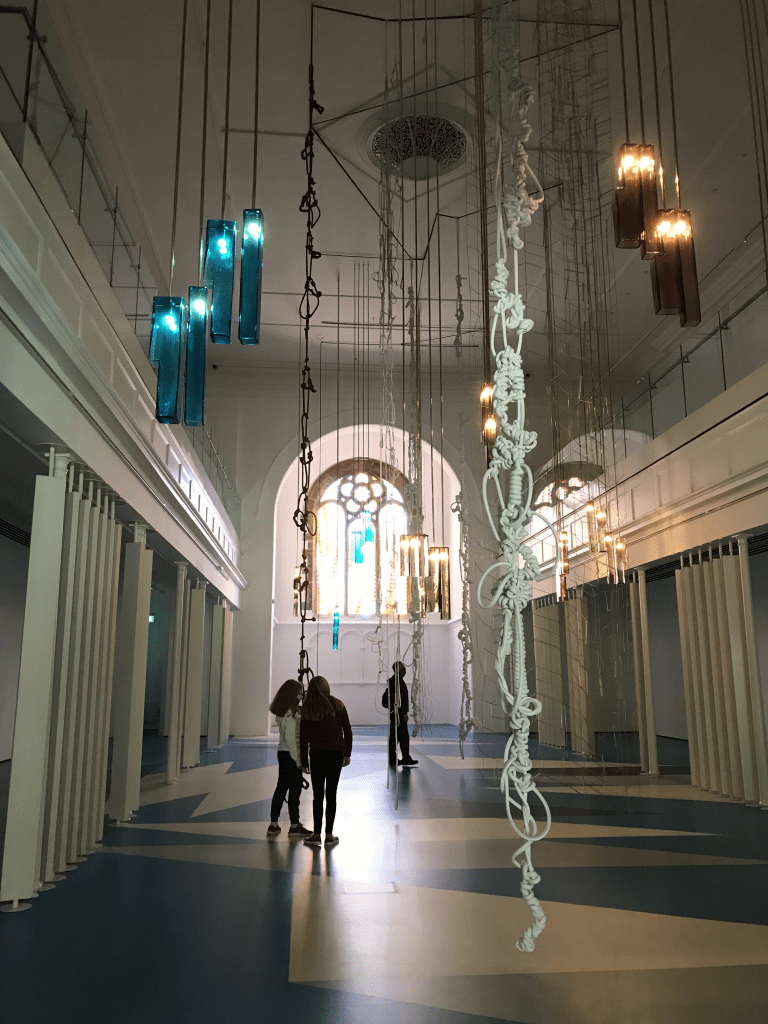
Leonor Antunes is a Portuguese artist whose work Sequences, Inversions and Permutations is currently showing in St Luke’s church, Plymouth.
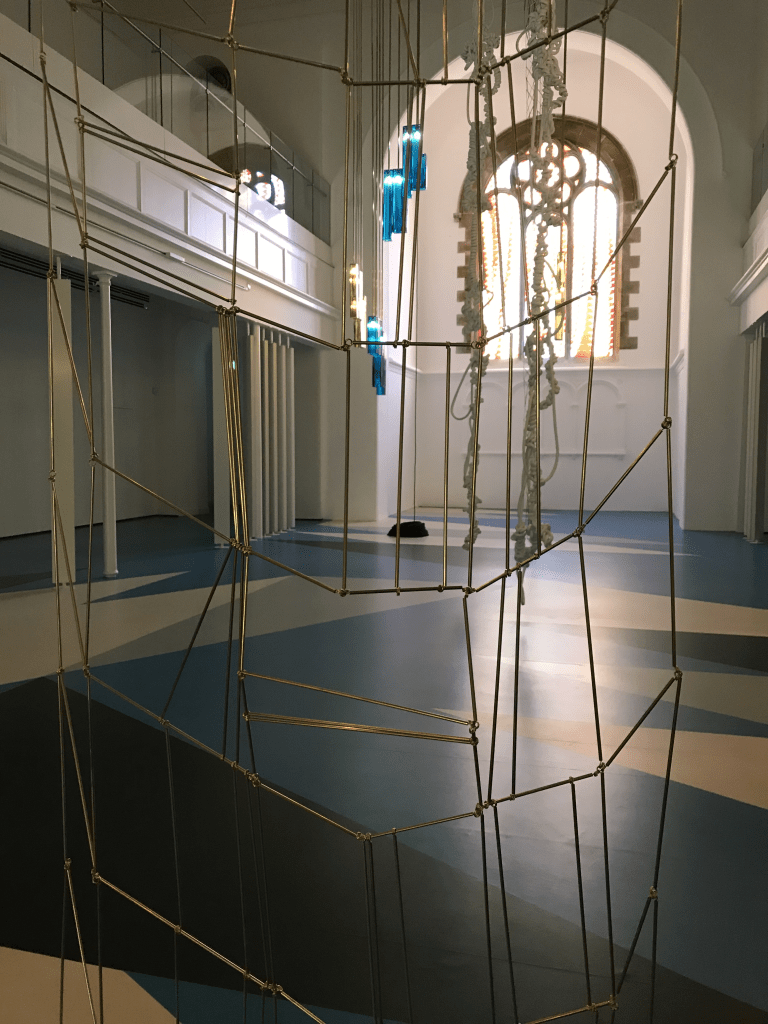
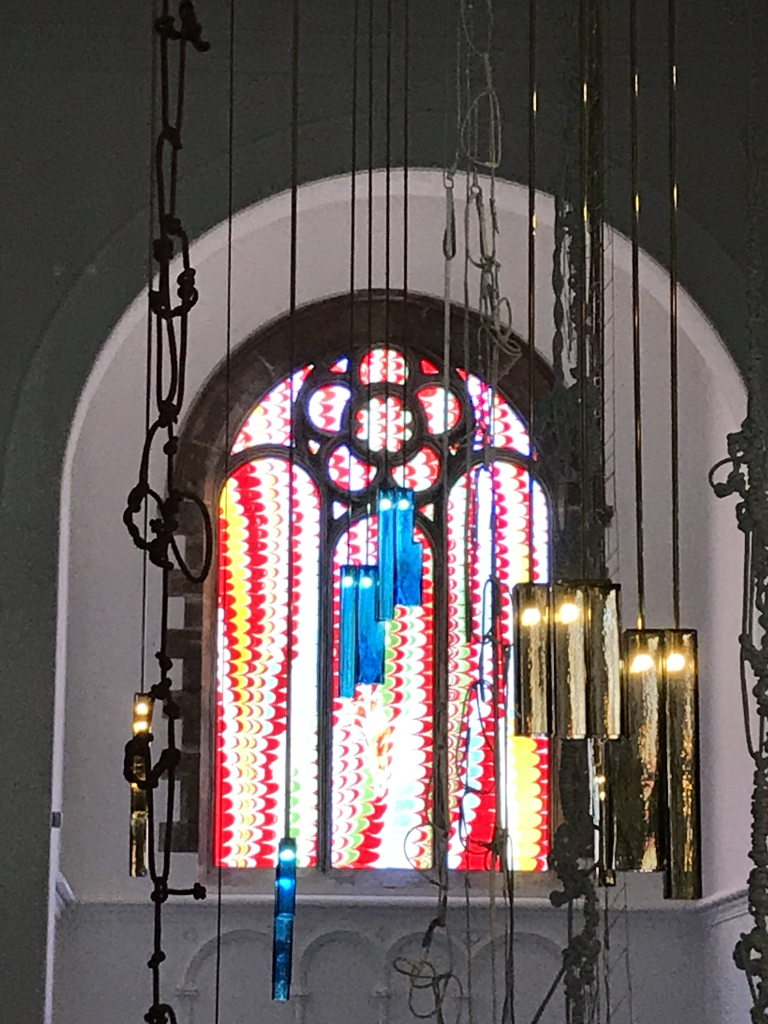
Antunes uses the physical building as an extension of her sculptures; they have been created specifically to exist in this space and it is clear that there is a dynamic tension between the two. Ropes, leather and Murano glass lighting hang from the ceiling, echoing the vertical lines of the columnar architectures, while metal netting mirrors the pattern on the floor, which she also designed along with the stained glass window. Knotted ropes provide a nod to Plymouth’s maritime identity and its historical ropemaking tradition. Each piece uses traditional materials in a nod to historic methods of production and as a foil to our ever-advancing digital world.
The overall result is serene and reverent, blurring the lines between art and architecture by using carefully chosen materials, movement, space, pattern, light and shadow to create interaction between the two.
Deborah Bright is an American artist, photographer, writer and professor. Her work on the settlement of the Pilgrim Fathers on America’s East Coast in the 1600s interests me, both in its execution and the historic links to my home town, Plymouth.
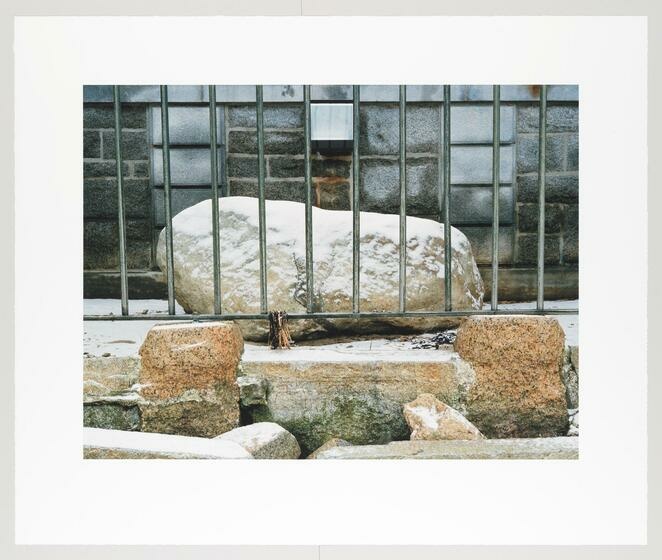
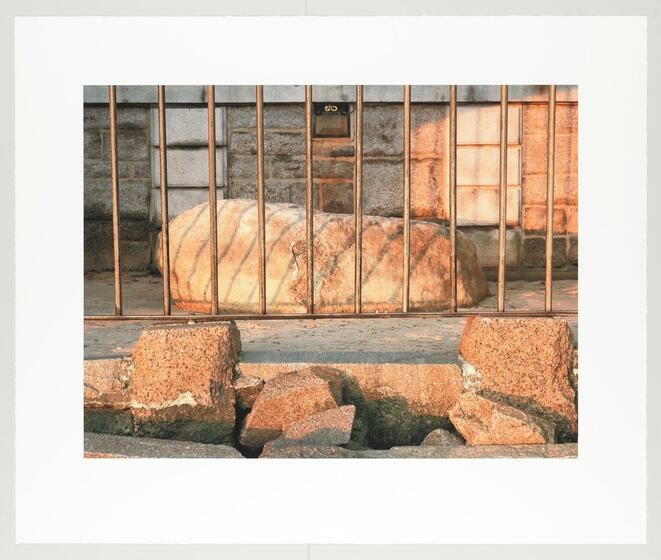
Glacial Erratic (2000-03) depicts the tourist attraction Plymouth Rock in Massachusetts. According to legend, the rock is where the Pilgrims landed when they first set foot on American soil.
Bright produced nine images of the rock taken at different times of the day and year. The rock itself appears to be insignificant, yet Bright manages to instil her works with meaning and symbolism. The title Glacial Erratic is a term for an Ice Age rock that was deposited during the glacial retreat into a non-native region, effectively a stranger amongst the surrounding rocks; different in composition, shape and colour. The link with the Pilgrim immigrants is therefore immediately evident.
2020 was the 400th anniversary of the Pilgrims’ ship the Mayflower’s sailing, and there has been a lot of discussion here in Plymouth about the consequences of their colonisation of the area, naming it New England in a claim to the territory. The history has previously been portrayed from a mainly one-dimensional perspective, largely ignoring the consequences on the Wampanoag Nation who ultimately lost their lands and homes despite initially working together with the Pilgrims.
Bright’s work reflects on the portrayals of the Pilgrims as founders of America by depicting the rock behind bars, thus questioning the ‘freedom’ assigned to them by historical records and questions the narrow white, male origin of America’s mythical foundation. The rock is paraded as a national symbol of liberty, discovery and adventure, yet Bright turns this around by enslaving it in a confined cell, thus questioning the motifs behind America’s ideological depiction of its past.
Due to an unforeseen change of tutor part-way through the module, some months passed between completion of Assignment 3 and receiving feedback for it. However, I am pleased with the positive feedback I have received, and my tutor’s assurance that the video I produced worked well and the music I chose was appropriate to the content and did help to evoke an emotive atmosphere as I had intended. I had considered the slideshow content and the music very carefully and spent some time deliberating over its composition as it was the first I have created so I am happy that the tutor has recognised what I was trying to achieve.
The tutor also recognised that I spent some time researching this assignment, reading two books on phsychogeography, in my bid to understand and elucidate the feelings of unease experienced when walking around my home city, Plymouth, during national lockdown in the COVID|-19 pandemic during 2020. He also noted that my learning log is progressing well.
During our video chat, he also commented on the strength of the remaining images on my contact sheet, and indeed this formed part of the dilemma I had in choosing the ‘right’ images for the slideshow; there were at least two different contextual directions I could have taken in the presentation. He therefore suggested that I produce a book containing the full, wider project that I conducted and this is something I intend to do as part of the final submission for assessment.
Overall, I am very pleased with the feedback for this Assignment.
Zoe Leonard is an American artist working mainly with sculpture and photography. Based in New York, her work explores themes such as loss, the passing of time, displacement and repetition.
For her 1995 work Strange Fruit, in response to the death of a close friend, she sewed the skins of fruit such as oranges, lemons and grapefruit together with wire, thread and zips, in a nod to vanitas still life paintings of the 16th and 17th centuries, suggesting the fleeting and finite nature of life. The work evolves and decays as time passes until eventually it is gone, a theme which I am very interested in and which is reflected in my work depicting the imprints left by human activity on grass.
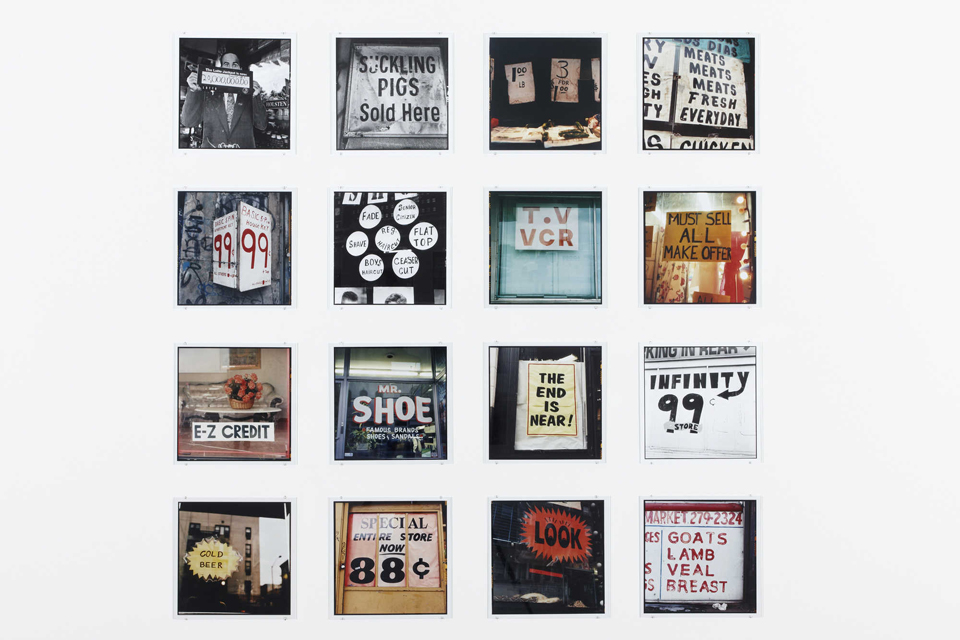
She continues her interest in the passage of time in her series Analogue, this time investigating the disappearing landscape of 20th century urban life with photographs of shop fronts, taken on a vintage 1940s Rollaiflex camera to reflect the nature of obsolescence in an increasingly globalised economy. Tracing the circulation of recycled merchandise, Leonard visited roadside markets in locations such as Cuba, Africa and the Middle East and presented the resulting images in a series of repetitive grids.
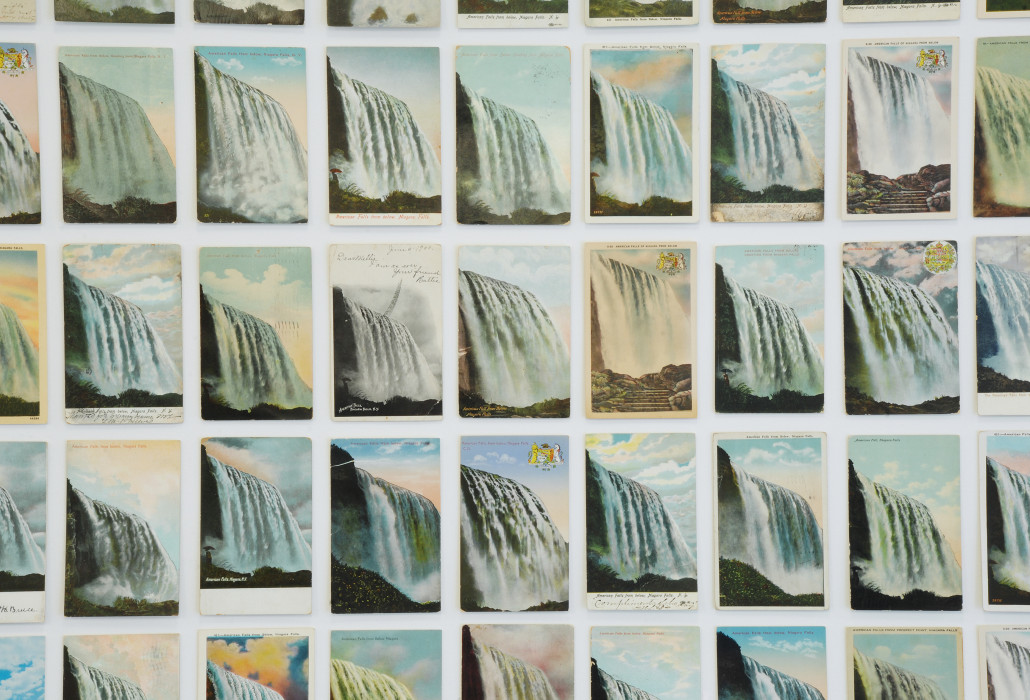
For her 2008 work You See I Am Here After All, she takes a different view on the passage of time, this time presenting thousands of postcards she has collected of Niagara Falls, dating from the early 1900s to the 1050s. This work is a commentary on the commoditising of nature by the tourist industry, showing how repetitive depictions of famous landmarks were used by the industry to infiltrate iconic symbols from nature into mass culture, and on the generic depictions of the picturesque.
This blog shows continuing progress of my coursework for the module "Digital Image and Culture" in the photography degree for the Open College of the Arts.

 Rhonda's Landscape blog