Assignment 4: Critical Review
Contemporary discourse surrounding Landscape photography considers how landscape photographers can move beyond mere observation of the land and become more deeply immersed in what surrounds them. In his book Camera Lucida, Roland Barthes questions whether landscape is ‘itself only a kind of loan made by the owner of the terrain’, thus suggesting ownership of the photographic subject. If Barthes’ statement is true, can we establish a greater and more direct connection with the land; to remove that level of distance that he suggests?
Land Art moves beyond representation as the artists strive to work with the land, often nature, rather than being a step further removed, looking at the land. A stone is not a representation of a stone in the form of a drawing, or a human-crafted sculpture made from representative materials; it is an actual stone, thus the land becomes the artwork. If, as John Ruskin states in Modern Painters: Of Mountain Beauty, ‘a stone, when it is examined, will be found a mountain in miniature’, then the scope for Land Artists is immense. However, if the land is the artwork, what does the viewer who visits a gallery see when they look at photographs of the artwork? Are they merely viewing reproductions, like visiting the Louvre to see a poster of the Mona Lisa rather than the painting itself? What does the photograph bring to Land Art? And what can Land Art bring to landscape photography?
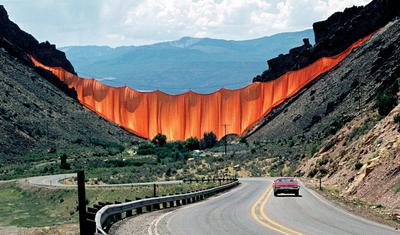
At first glance, photography’s role in Land Art is straightforward; unable to bring a piece of work that spans several miles to the gallery, Land Artists rely heavily on photography to bring their work to a wider audience and engage with the art market. For example, the large-scale works of Christo and Jeanne-Claude rely heavily on photography to be brought to a wider audience: works such as Valley Curtain in Coloarado; a 381m wide gigantic orange-red coloured curtain in the Rocky Mountains.
With nothing physically to sell, the land artist subverts the art market by preventing the traditional big money sales of objects to be displayed in a multi-millionaire collector’s home. The Christos’ hugely expensive projects are largely self-funded by the sale of drawings with the occasional top up from grants.
Bringing these works into the gallery setting in some way is also necessary for some of the Land Artists who work in remote and inaccessible places to get their work seen,. Without a viewer, the art is arguably an expression of the artist’s ideas that no-one else sees; akin to a diary, or an artist’s sketchbook piece, a private musing for the protagonist’s own artistic progress (of course this is only one point of view as the discourse around ‘what is art’ is varied and lengthy). Thus, the photograph also serves as a tool for the communication and conveyance of the artist’s idea, a means of engaging the viewer, a method of transforming the work from sketchbook piece to ‘art’. The gallery in such instances becomes the artists’ forum for communication; the photograph the medium of that communication. Thus the photograph becomes the replacement for the original art piece, that is to say its tangible or visible form, an extension of the original. In his book In Land, Ben Tufnel defines Land Art as ‘a form of Conceptual art that engaged with earth and landscape’. Tate.org.uk describes Conceptual Art as ‘art for which the idea (or concept) behind the work is more important than the finished art object’. Thus the idea is key; the format (or existence) of the physical artwork itself is secondary. Gombrich in A World History of Art reinforces this perspective by stating that the photograph in Conceptual Art was ‘not thought of as another category of art to be placed alongside painting and sculpture, it was a carrier of ideas and cultural messages’. Gombrich goes on to state that the photograph of Conceptual Art was not an ‘art object’ in itself ‘to be appreciated for its formal, expressive or other aesthetic qualities’.
However, Nancy Holt’s view of the photograph’s role in Land Art is in contrast with that of Gombrich as discussed during a conversation about Robert Smithson’s mirror work Mirror Displacement at Chesil Beach Dorset in a 2019 interview with Simon Grant for Tate Etc: ‘It is interesting to think about the fact that an artist takes his material with him into the landscape, sets it up, makes a sculpture and then photographs it, and the photograph becomes the art. The landscape and the art can shrink to the size of something you can put in your pocket – the size of a slide’.
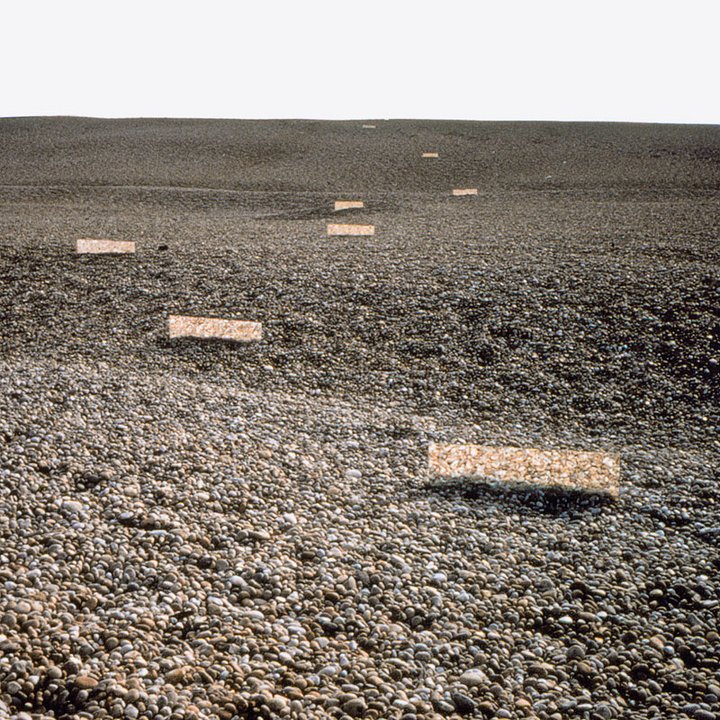
Holt’s view that the photograph becomes the art is reinforced further when considering how artists have photographed the works. The composition is often carefully considered; in the example above, the image has been captured to show the mirrors reflecting the stones arranged in a line that meanders from side to side and ultimately leads the eye through the full depth of the image. The sky is included but featureless and pale grey; similarly there are no landmarks such as the concrete walls that flank Chesil Beach to be seen. The image is cropped so that the beach appears to be a wilderness; there is nothing to give a sense of scale to the viewer and one imagines the furthest mirror to be far in the distance. There is no hint of the nearby sea. By careful composition and omission of unwanted elements, the artist can construct a landscape that they want the viewer to see and create a photograph that goes beyond simple reproduction and can become an artwork in itself.
Similarly, in his book Land Art and Land Artists, William Malpas notes that ‘Andy Goldsworthy photographs his sculptures often looking down on them, so the surrounding landscape is not seen. He edits out unsightly buildings or roads’. The Land Art photograph is sometimes not merely a reproduction, then, but, on a simplistic level, a work in its own right that has been edited in some way by the artist or their collaborator. I think the full truth lies somewhere between Holt’s view that the photograph becomes the art and Gombrich’s that it is merely a carrier of messages; that the photograph is a bridge to the real artwork for the viewer and that an element of participation and imagination is required from the viewer to connect and complete the whole artwork. Indeed, Malpas reports that Goldsworthy himself has said ‘that it is important for the viewer of his art to fill in the gap between the photograph of the sculpture and the real sculpture that he made someplace else.’ Thus a level of interpretation and interaction is required by the viewer.
In contrast, walking artist Richard Long claims to want to make photographs of his work as simple and straightforward as possible. In Michael Lailach’s book Land Art, he quotes Long as having said ‘the photograph should be as simple as possible…because my art is very simple and straightforward, I think the photographs have got to be fairly simple and straightforward.’ Long’s locations are often anonymous, his walks solitary; the viewer is never expected to be able to view the work in the traditional sense but can only know his work through photographs, text and maps. What the viewer experiences is his memory, what he saw whilst making the walk. As Liz Wells states in her book Land Matters, ‘they record something of that which was experienced … for the audience this is a story recounted, in word and image, … an account that testifies to the experience of the walker but cannot replicate it.’ Long’s photographs bring to the viewer’s mind their own recollections of similar walks and thus the viewer’s own reaction to Long’s images is influenced by their own experiences and preconceptions of walking. In a way, this is linked to the family holiday photograph; upon seeing someone else’s family album we can recognise and identify with their experiences and, on examining our own thoughts further, can imagine events and settings beyond the actual image itself. in the same way, the viewer must metaphorically place themselves in the shoes of the artist walker to fully gain an affinity with the ‘art’, that is the experience of walking itself.
For all of Land Art’s revolutionary nature, the eschewing of the traditional arts markets and materials, and Long’s claims that his photographs are purely documentary, a look on Long’s website at photographs of his ‘sculptures’ reveals a reasonably traditional, picturesque approach to landscape photography. With a penchant for dramatic landscapes, his images carry a touch of the sublime and follow conventional rules on composition, horizon lines, leading lines, depth of field and so on.
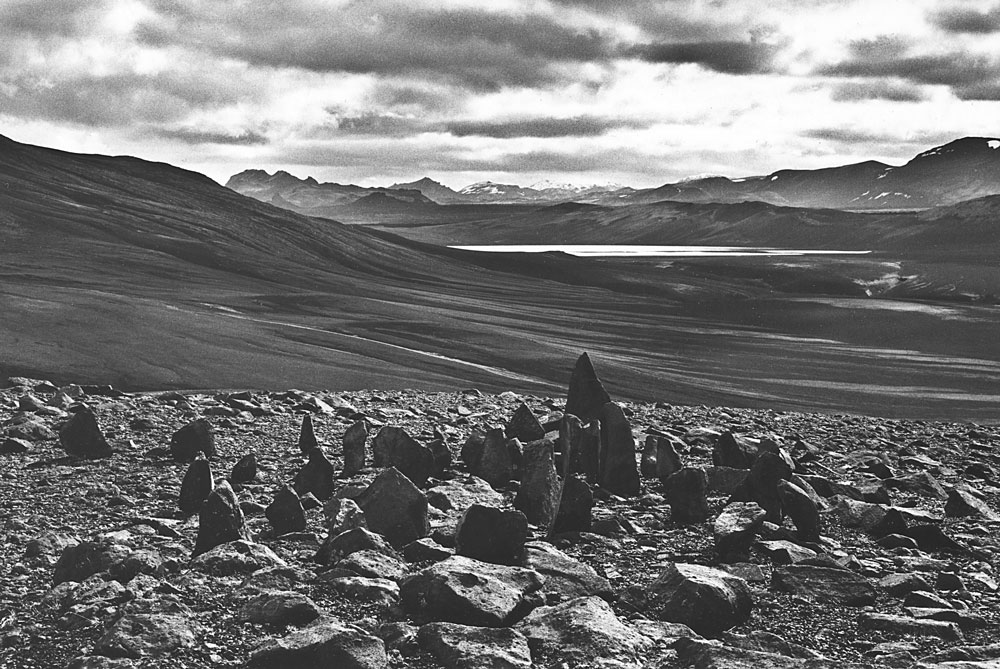
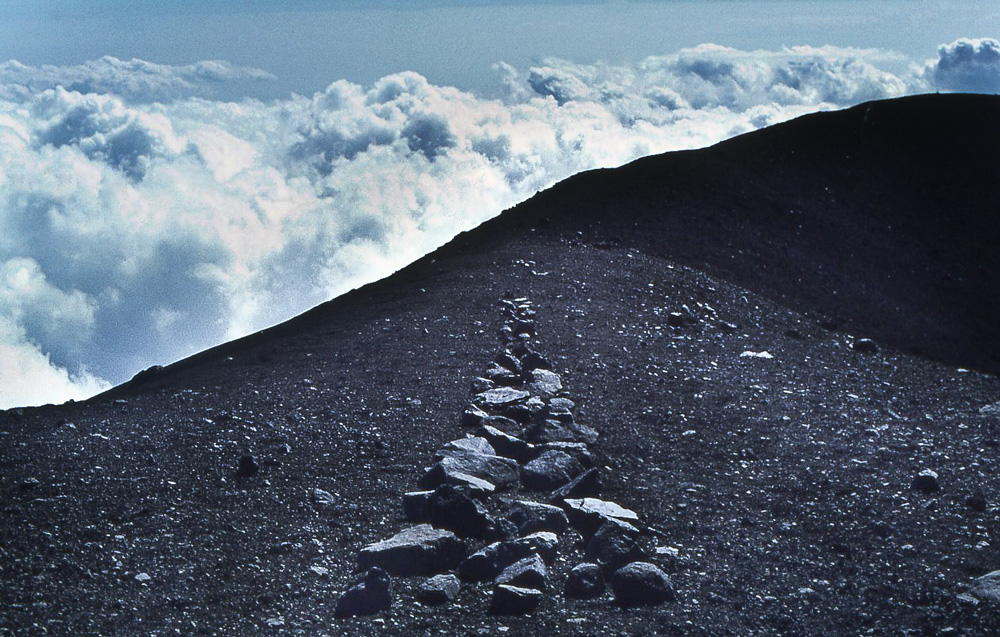
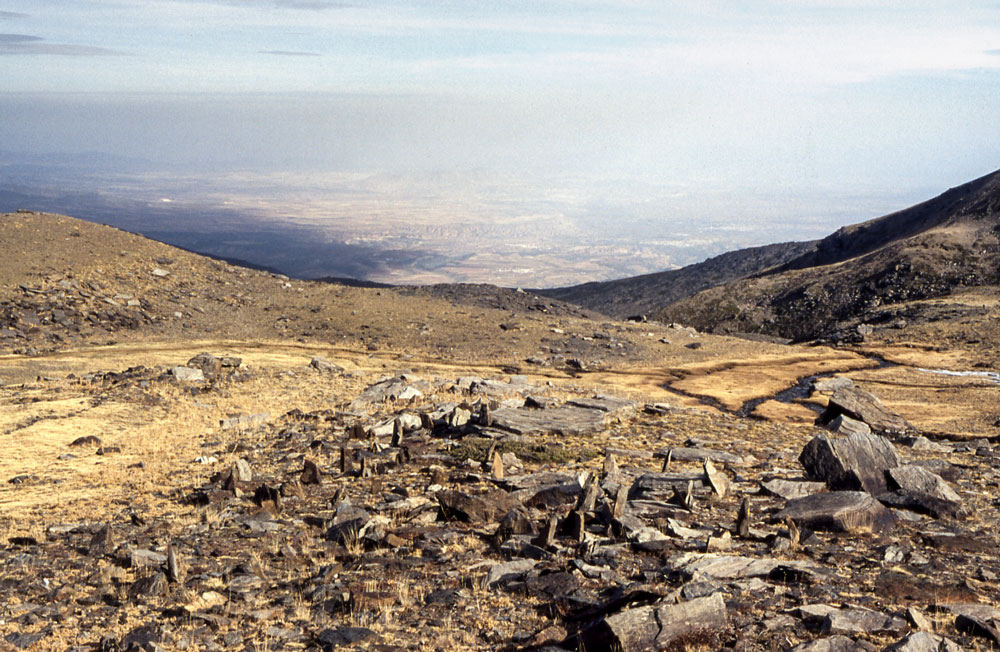
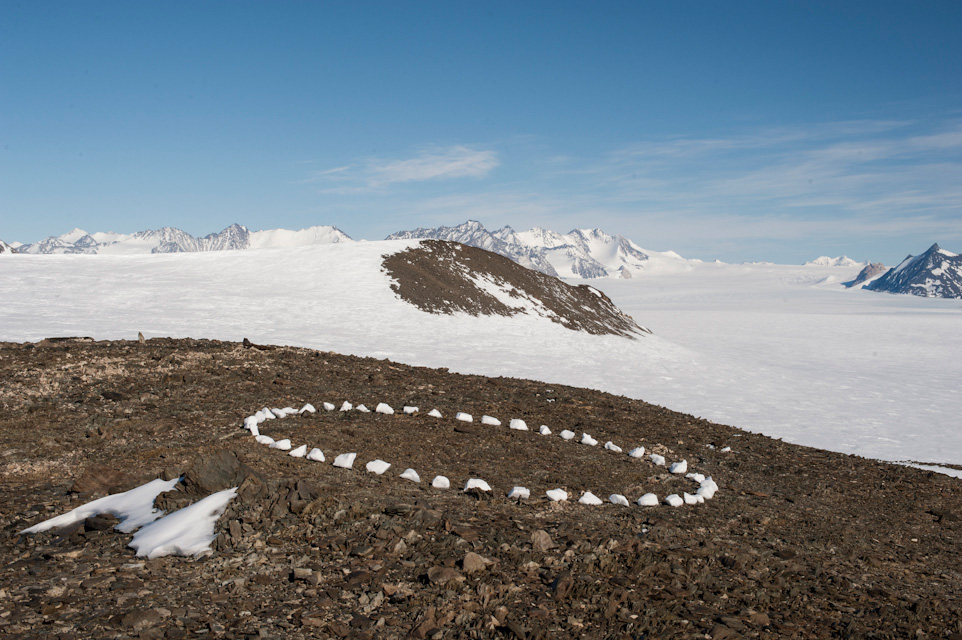
Of course, once many of Long’s walks are complete, the photographs are the only thing that remains as evidence that they actually happened. There can never truly be proof that events such as Long’s solitary walk actually did happen; he could be making it up. As Malpas states: ‘How does one know something is ‘the real thing’, when all one knows of it is through images’. And yet, throughout the history of photography we see images repeatedly trusted as document to an incontrovertible truth. In Land Art, stones may get moved or be so arranged that they do not register with a passerby as a deliberate act; lines in the grass are even more ephemeral, lasting mere hours. This is the case with the work of many Land Artists and indeed some works lasted only minutes or even seconds: Hans Haacke’s Sky Line, for instance, was a performance staged in Central Park, New York whereby he released a number of white balloons affixed to fishing wire into the sky, to be taken up and away by wind energy. As the Phaidon-published book Hans Hacke states, ‘Hacke’s works with air relied totally on the artwork’s functioning in time.’ Photography thus becomes the essential medium for recording the event, Roland Barthes’ That-has-been’; documentary evidence that it really happened.

Transition and transformation are key attributes of Land Art; after all its media, the land and landscape are in a continual state of flux. Robert Smithson’s Partially Buried Woodshed had twenty truckloads of earth loaded onto it until its central roof beam cracked. The work was designed to slowly break up under the weight of the earth and be gradually taken over by nature. On land owned by Kent State University, Ohio, the work was graffitied upon with an anti-war slogan by protesting students, before being mysteriously cleared away over a decade later. The photograph becomes evidence of the changes in such artworks, where even the artist cannot witness every subtle development without living on site and the viewer may only see it once in person, if at all. The photograph becomes a marker of history, capturing a moment in time. In a way the photograph becomes the opposite of the Land Art, recording, preserving, freezing while the art is constantly evolving, unfixed, changing, impermanent. The photograph becomes the supplementary story of the work’s development over time.
One of the enduring attractions of photography is its ability to perform so many different functions in a succinct form and its use in Land Art is a prime example of this. The photograph as document, a piece of history, record, conduit for ideas, autobiographical statement, evidence of existence, or a piece of art in its own right; photography and Land Art form a symbiotic relationship where each feeds and enhances the other. Photography is a vehicle which traverses the barriers to bring Land Art to the majority of its viewers: those who cannot view it in situ. And perhaps Land Art, particularly that by the more subtle practitioners like Richard Long and Andy Goldsworthy, can act as a guide to the landscape photographer, for if we take the cue of artists like Long who consider the process to be of more importance than a physical object, maybe landscape photographers could alter their mindset to incorporate the process of making images as part of the work itself rather than solely concentrating on the end result, and thus can surely become closer to the land by engaging more holistically than merely viewing and photographing.
References:
Barthes, R. (1982) Camera Lucida: reflections of photography. London: Jonathan Cape
christojeanneclaude.net [Accessed 10 January 2021]
http://www.tate.org.uk [Accessed 10 January 2021]
Nancy Holt and Robert Smithson in England, 1969: Notes from an ancient island – Tate Etc | Tate
Lost Art: Robert Smithson – Essay | Tate [Accessed 28 January 2021]
Tufnel, B. (2019) In Land: Writings Around Land Art and its Legacies. Alresford: John HUnt Publishing
Malpas, W. (2013) Land Art in Great Britain (3rd ed.). Maidstone: Crescent Moon Publishing
Lailach, M. (2007) Land Art. Köln: Taschen GmbH
Ruskin, J (2018) Modern Painters, Vol. 4 of 5: Mountain Beauty (Classic Reprint). London: Forgotten Books
Grasskamp, W. Nesbit, M. Bird, J (2004) Hans Haacke. New York: Phaidon
Wells, L. (2011) Land Matters. New York: I.B.Tauris & Co Ltd
 Rhonda's Landscape blog