Sharon Boothroyd’s WeAreOCA article Online Exhibitions invites us to consider the slideshow format of presenting images, using Andy Adams’ Looking at the Landas an example.
At first I was daunted at the prospect of watching an eighteen minute slideshow; I thought my mind would wander part way through. I was also surprised that there was no music; my preconception was that this would be required to create ambience and to bring the exhibition, which is by different photographers, into a unified whole. On both counts I was wrong; the exhibition was utterly engaging and the absence of music enhanced the subdued feel of the images, which were often very simple in composition and at times reminded me of Mat Hennek’s Silent Citiesseries.
Overall, I really enjoyed the piece and saw a number of intriguing images that I would like to return to. I suppose the main downside of the format is the inability to linger longer over certain images, though that is easily overcome by further investigation by the viewer.
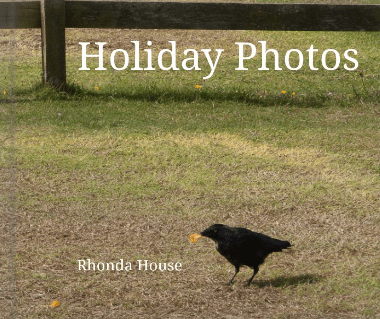
For this exercise I have prepared a mock up submission for Assignment five using book software from Blurb. I have used Blurb before so found the software relatively easy to use. I have a personal preconception that a photographic book needs text to accompany the images (even though i have purchased ones that do not) and for that reason I probably would not consider a book as my choice of presentation for this particular assignment since I want to present the images without text. However, it is a medium I would consider for future projects should I deem it appropriate.
The purpose of this exercise is to research different companies offering inkjet (giclée) and C-type printing. All prices are for A3 prints as this is a size commonly used for portfolio purposes. I have included descriptions of the options as described on the websites because I am not well versed in the differences between the different types.
Company 1: DS Colour Labs
C-Type Prints – described as ‘Silver Halide printing light-sensitive paper and silver based chemistry, a technology which has been constantly refined over time.’
Lustre £1.20
Gloss £1.20
Pearl £7.49
Velvet £7.49
Lustre – ‘a very natural photographic finish reminiscent of traditional photographic printing. Coated with a slightly stippled texture Lustre prints are very resistant to fingerprints, scratches and scuffs and feature a semi-matt finish with minimal glare.’
Gloss – ‘produces higher contrast in your work with a vivid, glossy finish which accentuates the colour to give a punchy, rich feel.’
Pearl – pearl-like crystals give a unique high-gloss effect and add a beautiful iridescent touch to your photos with deep blacks and purer highlights
Velvet – ‘professional coating with a zero-reflective top layer creates a stunningly soft and deep- matte effect…..enhanced color reproduction, white purity and excellent image stability.’
GicléePrints – highest quality, archival digital inkjet prints available.
Permajet – £10.99
Hahnemuhle – £11.99
PermaJet – T’he image reproduction will surpass your expectations in all areas providing images that meet the highest standards of Museum quality giclee prints. Photographers and artists will appreciate the natural heavyweight feel and smoothness of the range as well as the subtle, yet varying, base colours which bring your images to life and add a sense of depth and clarity which cannot be reproduced on a normal gloss or satin paper.’
Hahnemuhle Photo Rag – The fine, smooth surface and feel of Photo Rag make this paper very versatile and it is ideal for printing both black and white and colour photographs and art reproductions with impressive pictorial depth.
I note that the offer sample packs to enable comparison of the different papers and this is something I intend to look into further to improve my knowledge of the variances.
Company 2: Loxley Colour
C-Type Prints
Loxley’s offering is very similar to that of DS, apart from the inclusion of Metallic instead of Pearl. Metallic is described as ‘A beautiful shining paper that is perfect for those showstopping images. The Metallic print finish adds a sheen to images with an almost reflective appearance.’
Lustre £4.52
Gloss £4.52
Metallic £6.77
Velvet £6.77
GicléePrints
Loxley offer a wide range of different papers from Fujifilm, Hahnemuhle and Epsom all priced at £12.99 each.
Company 3: Theprintspace
C-Type Prints
Again, the offering from theprintspace varies slightly from that of the other two, offering matt, gloss, flex (described as ‘super-gloss’) and metallic.
Matt £8.54
Gloss £8.54
Metallic £10.28
Flex £13.36
GicléePrints
Seven different papers are available, from Canson, Epsom and Hahnemuhle, all priced at £11.23.
The research shows there is a very wide range of different papers and pricing available and photographic printing appears to be something of a minefield to the inexperienced. I have used both DS Colour Labs and Loxley before and the only different I have found was that Loxley seem to offer a more premium service in terms of customer service and packaging but not necessarily in the finished product itself. This is an area I definitely need to improve my knowledge in and I will allocate some expense to trying out the different options later in the year.
Technically, it could be argued that an inkjet print is not a photograph because they are created by laying ink onto a sheet of paper rather than being photography in its purest sense and I am inclined to agree, also the argument is a little pedantic. It is, of course, still a print of a photograph, since the original image has been made with light. In practical terms, however, I would not be put off using or purchasing a print purely because it was an inkjet.
Thomas McEvilley’s introduction to Brian O’Doherty’s Inside the White Cube: the Ideology of the Gallery Space summarises the book as follows:
Modern art gallery spaces are built to a rigid set of rules; walls are white and there are no windows, thus the art is free to ‘take on its own life.’ The context is similar to that of religious buildings; the artworks appear out of time so take on their own status of appearing in limbo in a ‘chamber of eternal display.’ Egyptian tomb chambers which also built as a removal from the outside world, and from the flow of time, as were Paleolithic cave art chambers, which were deliberately set in areas which were difficult to access. These spaces are ritualistic and attempt to ‘cast an appearance of eternity over the status quo in terms of social values and also, in our modern instance, artistic values.’
O’Doherty states that, on entering the white cube, we give up our humanness – like in a religious building we do not speak, eat, drink, lie down, since or dance. The white cube attempted to bleach out the past and become a transcendental space, but the problem with transcendental principles is that they refer to another world.
Plato theorised that ‘at the beginning was a blank where there appeared inexplicably a spot which stretched into a line, which flowed into a plane, which folded into a solid, which cast a shadow, which is what we see’. The white cube represents the blank which Plato claimed everything evolved from.
It is interesting that the white cube is compared to a religious building as I have certainly felt a reverence when looking at iconic artworks similar to that within a cathedral and agree with the sensation of feeling out of time. However, the modern gallery is also often too overcrowded (pre-COVID) to gain that sense so that actually achieving it is rare. The aim of achieving commercial success by getting as many visitors in as possible does not easily align with the design sensibilities of the white cube and thus the effect is often lost.
Over the past few months I have spent some time pondering how landscape photographers can move beyond mere observation of the land and become more deeply immersed in what is around us. In Camera Lucida, Roland Barthes questions whether landscape is ‘itself only a kind of loan made by the owner of the terrain’ and I wondered whether, if this is true, we can establish a greater and more direct connection with the land; to remove that level of distance suggested by Barthes.
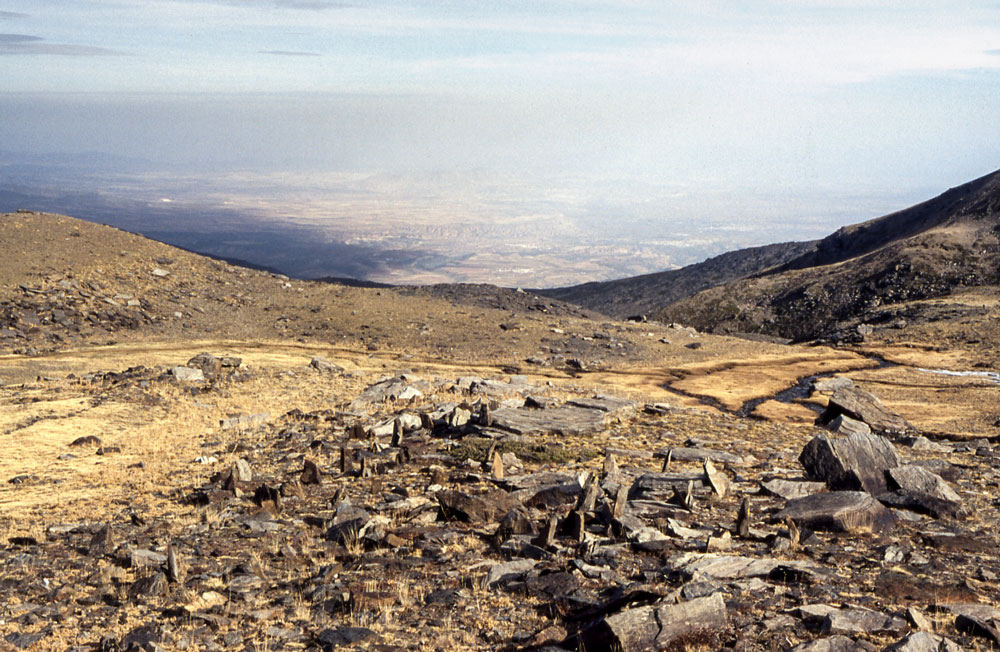
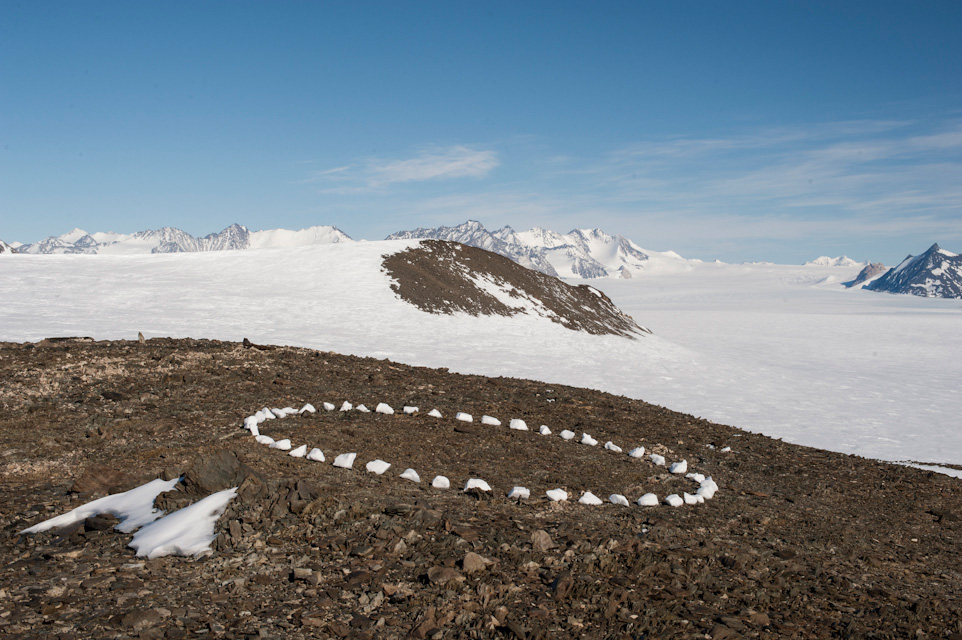
Land Art moves beyond representation as the artists strive to work with the land, often nature, rather than being a step further removed, looking at the land. A stone is not a representation of a stone in the form of a drawing, or a human-crafted sculpture made from representative materials; it is an actual stone, thus the land becomes the artwork. However, if the land is the artwork, what does the viewer who visits a gallery see when they look at photographs of the artwork? Are they merely viewing reproductions, like visiting the Louvre to see a poster of the Mona Lisa rather than the painting itself? What does the photograph bring to Land Art? And what can Land Art bring to landscape photography?
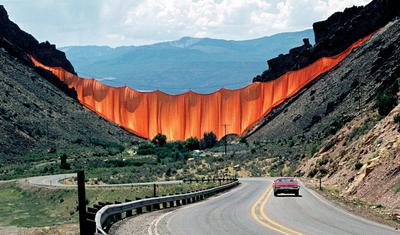
At first glance, photography’s role in Land Art is straightforward; unable to bring a piece of work that spans several miles to the gallery, Land Artists rely heavily on photography to bring their work to a wider audience and engage with the art market. For example, the large-scale works of Christo and Jeanne-Claude rely heavily on photography to be brought to a wider audience: works such as Valley Curtain in Coloarado; a 381m wide gigantic orange-red coloured curtain in the Rocky Mountains.
With nothing physically to sell, the land artist subverts the art market by preventing the traditional big money sales of objects to be displayed in a multi-millionaire collector’s home. The Christos’ hugely expensive projects are largely self-funded by the sale of drawings with the occasional top up from grants.
Brining these works into the gallery setting in some way is also necessary since without viewers, there is arguably no art. If there is no viewer, the art is merely an expression of the artist’s ideas that no-one else sees; akin to a diary, or an artist’s sketchbook piece, a private musing for the protagonist’s own artistic progress. Thus, the photograph also serves as a tool for the communication and conveyance of the artist’s idea, a means of engaging the viewer, a method of transforming the work from sketchbook piece to ‘art’. The gallery becomes the artist’s forum for communication; the photograph the medium of that communication. Thus the photograph becomes the embodiment of the original art piece, that is to say its tangible or visible form, an extension of the original. In his book In Land, Ben Tufnel defines Land Art as ‘a form of Conceptual art that engaged with earth and landscape’. Tate.org.uk describes Conceptual Art as ‘art for which the idea (or concept) behind the work is more important than the finished art object’. Thus the idea is key; the format (or existence) of the physical artwork itself is secondary. Gombrich in A World History of Art reinforces this perspective by stating that the photograph in Conceptual Art was ‘not thought of as another category of art to be placed alongside painting and sculpture, it was a carrier of ideas and cultural messages’. Gombrich goes on to state that the photograph of Conceptual Art was not an ‘art object’ in itself ‘to be appreciated for its formal, expressive or other aesthetic qualities’.
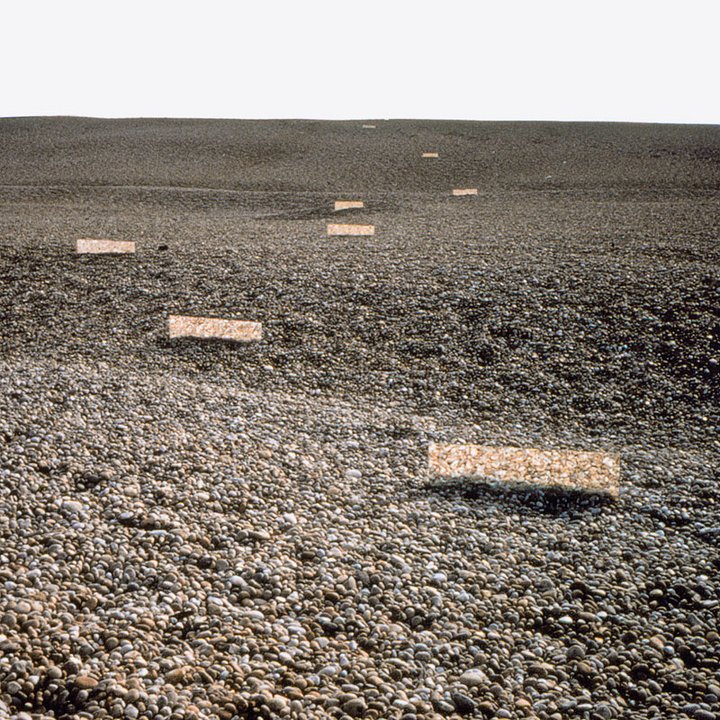
However, Nancy Holt’s view of the photograph’s role in Land Art is in contrast with that of Gombrich as discussed during a conversation about Robert Smithson’s mirror work Mirror Displacement at Chesil Beach Dorset in an interview with Simon Grant for Tate Etc: ‘It is interesting to think about the fact that an artist takes his material with him into the landscape, sets it up, makes a sculpture and then photographs it, and the photograph becomes the art. The landscape and the art can shrink to the size of something you can put in your pocket – the size of a slide’.
Holt’s view that the photograph becomes the art is reinforced further when considering how artists have photographed the works. The composition is often carefully considered; in the example above, the image has been captured to show the mirrors reflecting the stones arranged in a line that meanders from side to side and ultimately leads the eye through the full depth of the image. The sky is included but featureless and pale grey; similarly there are no landmarks such as the concrete walls that flank Chesil Beach to be seen. The image is cropped so that the beach appears to be a wilderness; there is nothing to give a sense of scale to the viewer and one imagines the furthest mirror to be far in the distance. There is no hint of the nearby sea. By careful composition and omission of unwanted elements, the artist can construct a landscape that they want the viewer to see and create a photograph that goes beyond simple reproduction and can become an artwork in itself.
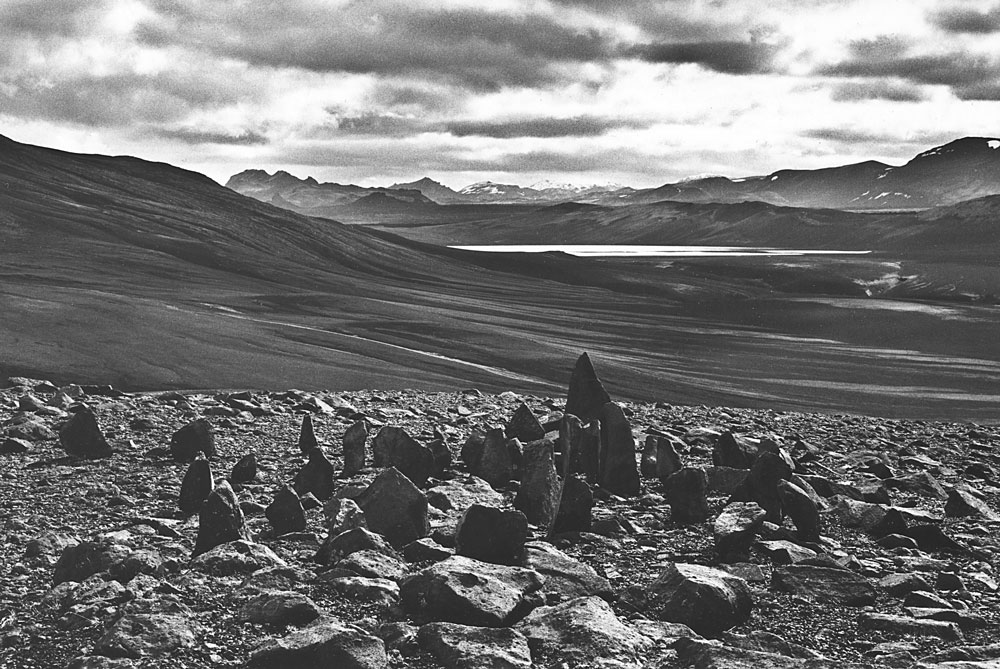
Similarly, in his book Land Art and Land Artists, William Malpas notes that ‘Andy Goldsworthy photographs his sculptures often looking down on them, so the surrounding landscape is not seen. He edits out unsightly buildings or roads’. The Land Art photograph is sometimes not merely a reproduction, then, but, on a simplistic level, a work in its own right that has been edited in some way by the artist or their collaborator. I think the full truth lies somewhere between, that the photograph is a bridge to the real artwork for the viewer and that an element of participation and imagination is required from the viewer to connect and complete the whole artwork. Indeed, Malpas reports that Goldsworthy himself has said ‘that it is important for the viewer of his art to fill in the gap between the photograph of the sculpture and the real sculpture that he made someplace else.’
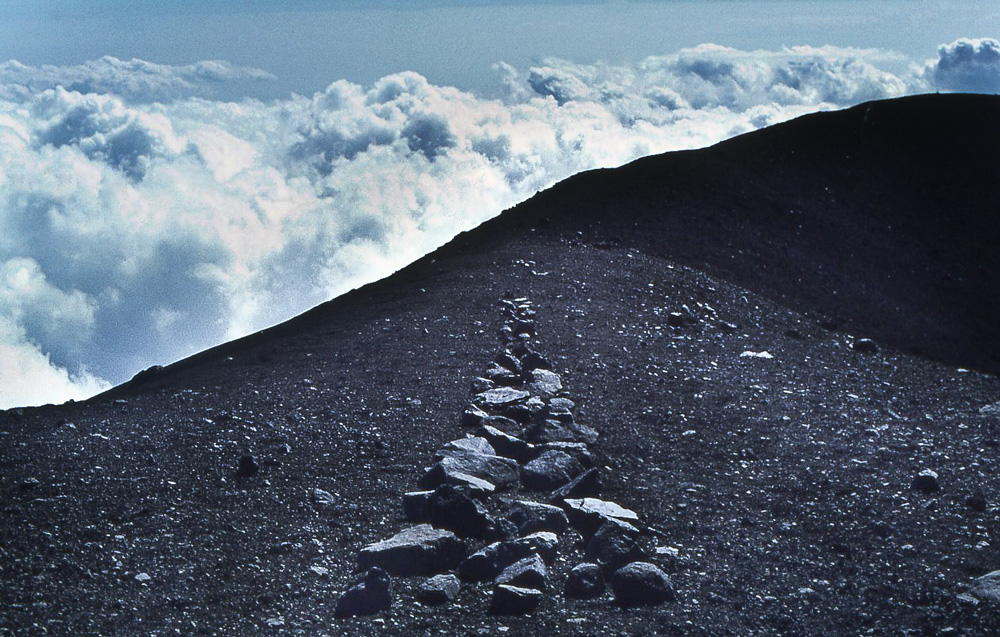
In contrast, walking artist Richard Long claims to want to make photographs of his work as simple and straightforward as possible. In Michael Lailach’s book Land Art, he quotes Long as having said ‘the photograph should be as simple as possible…because my art is very simple and straightforward, I think the photographs have got to be fairly simple and straightforward.’ Long’s locations are often anonymous, his walks solitary; the viewer is never expected to be able to view the work in the traditional sense but can only know his work through photographs, text and maps. What the viewer experiences is his memory, what he saw whilst making the walk. As Liz Wells states in her book Land Matters, ‘they record something of that which was experienced … for the audience this is a story recounted, in word and image, … an account that testifies to the experience of the walker but cannot replicate it.’ Long’s photographs bring to the viewer’s mind their own recollections of similar walks and thus the viewer’s own reaction to Long’s images is influenced by their own experiences and preconceptions of walking. In a way, this reminds me of the family holiday photograph; upon seeing someone else’s family album we can recognise and identify with their experiences and, on examining our own thoughts further, can imagine events and settings beyond the actual image itself. in the same way, the viewer must metaphorically place themself in the shoes of the artist walker to fully gain an affinity with the ‘art’, that is the experience of walking itself.
For all of Land Art’s revolutionary nature, the eschewing of the traditional arts markets and materials, and Long’s claims that his photographs are purely documentary, a look on Long’s website at photographs of his ‘sculptures’ reveals a reasonably traditional, picturesque approach to landscape photography. With a penchant for dramatic landscapes, his images carry a touch of the sublime and follow conventional rules on composition, horizon lines, leading lines, depth of field and so on.
Of course, once many of Long’s walks are complete, the photographs are the only thing that remains as evidence that they actually happened. There can never truly be proof that events such as Long’s solitary walk actually did happen; he could be making it up. As Malpas states: ‘How does one know something is ‘the real thing’, when all one knows of it is through images’. And yet, throughout the history of photography we see images repeatedly trusted as document to an incontrovertible truth. In Land Art, stones may get moved or be so arranged that they do not register with a passerby as a deliberate act; lines in the grass are even more ephemeral, lasting mere hours. This is the case with the work of many Land Artists and indeed some works lasted only minutes or even seconds: Hans Haacke’s Sky Line, for instance, was a performance staged in Central Park, New York whereby he released a number of white balloons affixed to fishing wire into the sky, to be taken up and away by wind energy. As the Phaidon-published book Hans Hacke states, ‘Hacke’s works with air relied totally on the artwork’s functioning in time.’ Photography thus becomes the essential medium for recording the event, Roland Barthes’ That-has-been’; documentary evidence that it really happened.
Transition and transformation are key attributes of Land Art; after all its media, the land and landscape are in a continual state of flux. Robert Smithson’s Partially Buried Woodshed had twenty truckloads of earth loaded onto it until its central roof beam cracked. The work was designed to slowly break up under the weight of the earth and be gradually taken over by nature. On land owned by Kent State University, Ohio, the work was graffitied upon with an anti-war slogan by protesting students, before being mysteriously cleared away over a decade later. The photograph becomes evidence of the changes in such artworks, where even the artist cannot witness every subtle development without living on site and the viewer may only see it once in person, if at all. The photograph becomes a marker of history, capturing a moment in time that cannot be replicated. In a way the photograph becomes the opposite of the Land Art, recording, preserving, freezing while the art is constantly evolving, unfixed, changing, impermanent. The photograph becomes the supplementary story of the work’s development over time.
One of the enduring attractions of photography is its ability to perform so many different functions in a succinct form and its use in Land Art is a prime example of this. The photograph as document, a piece of history, record, memory, conduit for ideas, autobiographical statement, evidence of existence, or a piece of art in its own right; photography and Land Art form a symbiotic relationship where each feeds and enhances the other. Photography is a vehicle which traverses the barriers to bring Land Art to the majority of its viewers: those who cannot view it in situ. And perhaps Land Art, particularly that by the more subtle practitioners like Richard Long and Andy Goldsworthy, can act as a guide to the landscape photographer, for if we take the cue of artists like Long who consider the process to be of more importance than a physical object, maybe landscape photographers could alter their mindset to incorporate the process of making images as part of the work itself rather than solely concentrating on the end result, and thus can surely become closer to the land by engaging more holistically than merely viewing and photographing.
References:
christojeanneclaude.net [Accessed 10 January 2021]
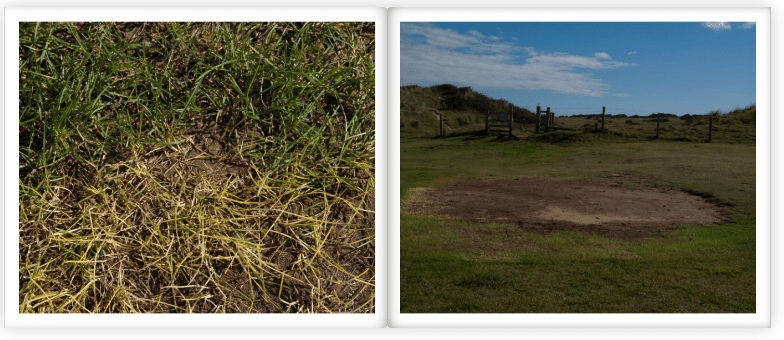
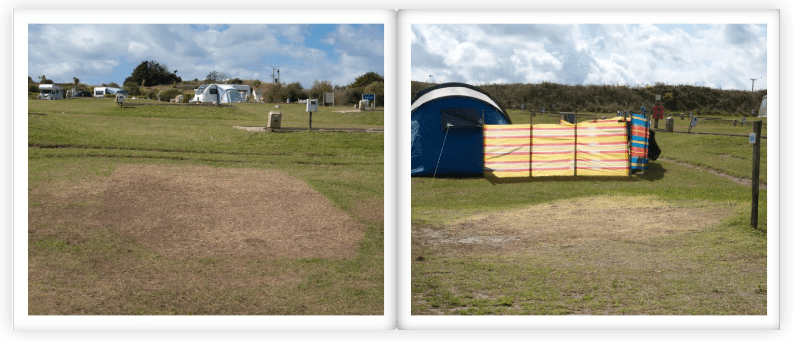
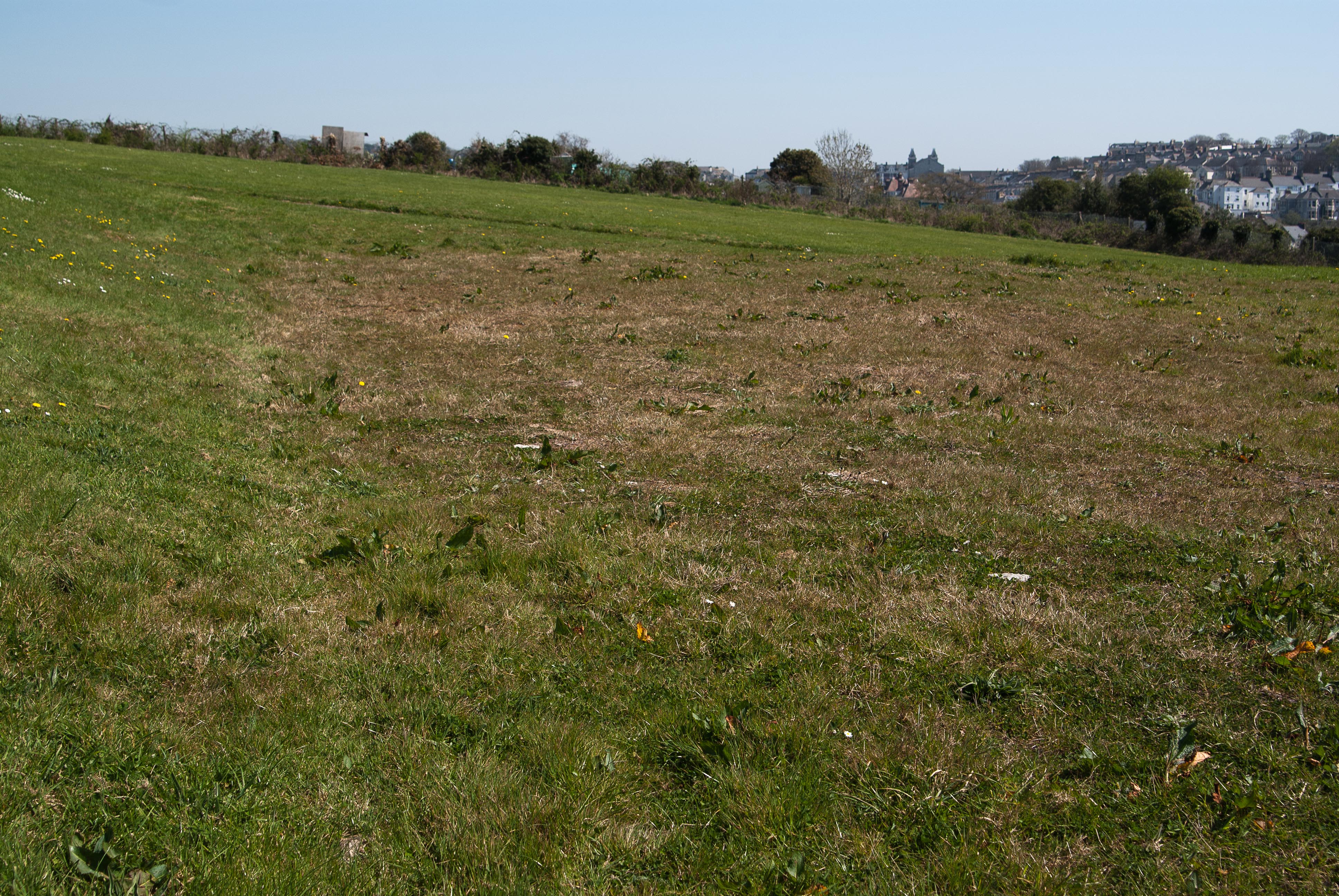
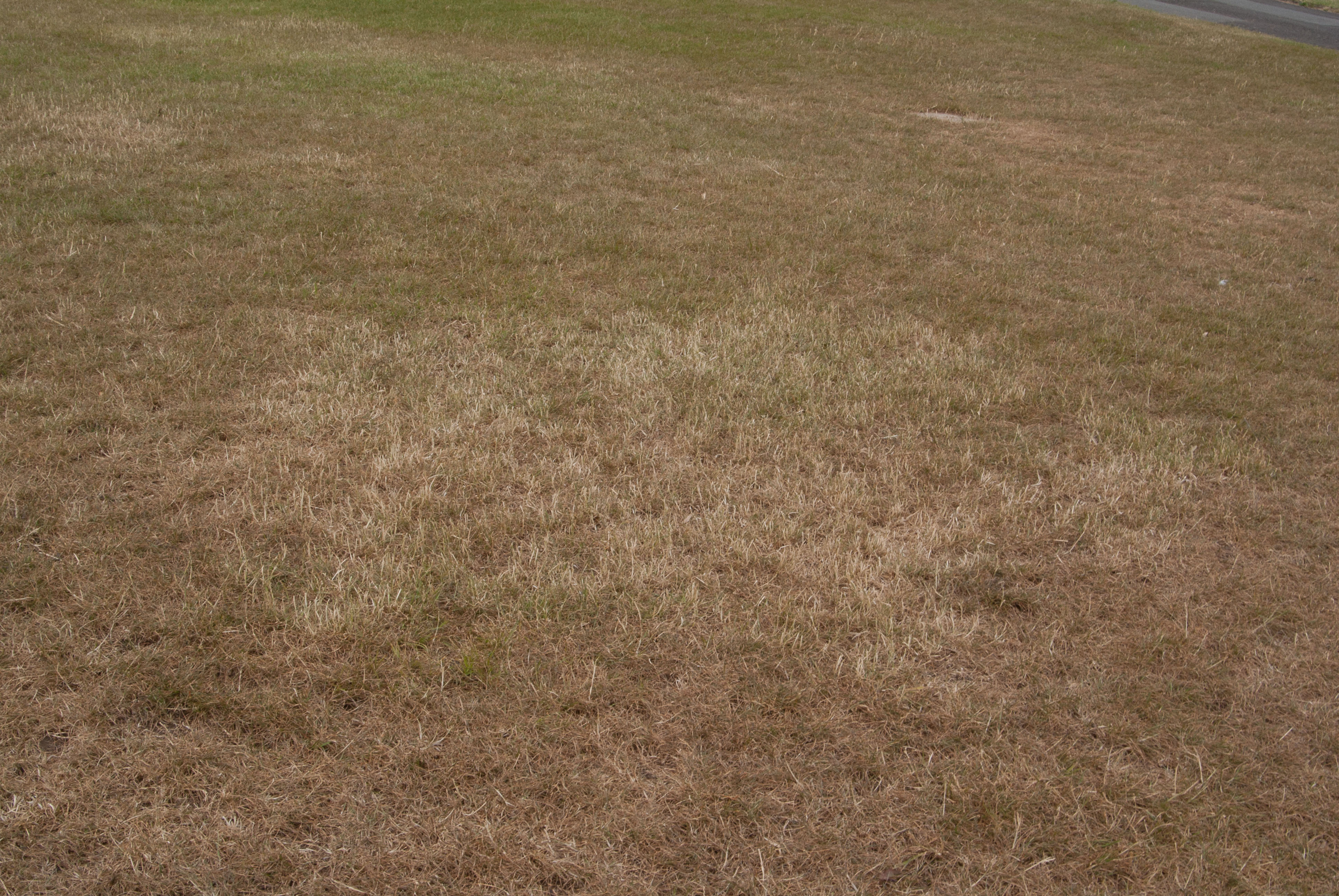
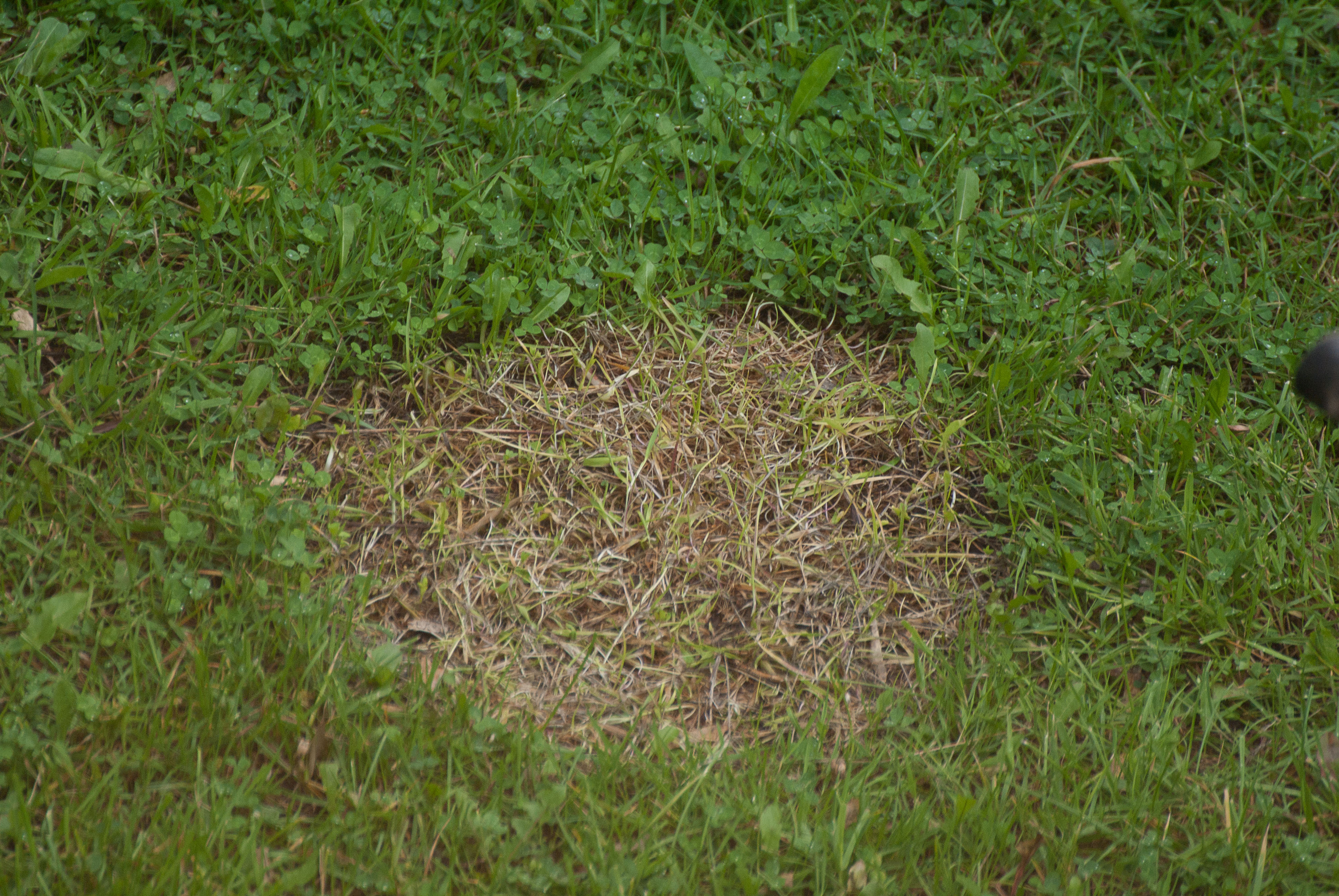
Around two years ago I became interested in how the marks on grass when it has been deprived of light are a kind of naturally occurring photography which, when an item is placed on it for a period of time and subsequently removed, create a silhouetted ‘image’ of that which has been placed there.
I began collecting images of this type of ‘photography’ when I came across it whilst out walking with my camera, whilst wondering what had previously been there to leave the image. Some large areas were indicative of a temporary structure of some sort, hinting at a gathering for an unknown occasion, whereas others were very small.
Inspired by artists challenging what constitutes photography such as Tom Lovelace, following on from my earlier work for this module using the sun to create cyanotypes and lumen prints, and also referencing my research on Land Art, I wanted to explore further these images that are made on the earth itself, which break through the limitations of photographic paper size boundaries.
I also bring to my work a personal interest in the family photo album, and particularly in the images we retake year after year in different forms, for example the holiday snap or the birthday party, and the idea that versions of these images are taken year after year, generation through generation. We are so familiar with these images that when we view someone else’s version, we can immediately imagine the scene beyond the boundaries of the shown image and subconsciously apply our own preconceptions and experience of the our imaginings. Thus it is so with the British caravan park; many people already have their own thoughts on what it is to holiday in this environment.
My project proposal is to combine the interests laid out above and explore how the images created by objects blocking natural light on grass create a new type of holiday photograph, that which hints at what has occurred at the particular site but leaves the viewer to imagine the scenes contained within that confined area of ground.
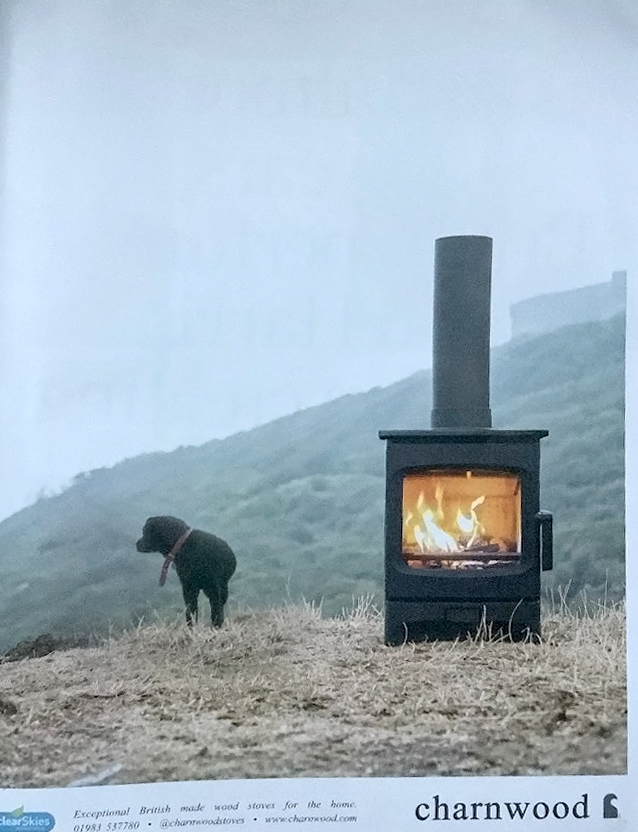
For this exercise we were asked to choose an advertisement with identifiable signs. This term comes from semiotics as discussed in the 1977 Roland Barthes essay Rhetoric of the Image. According to Barthes, the sign consists of a signifier and a signified, or, in other words, what is depicted and the message it connotates. There is also a second level of meaning, myth, which relates to the viewer’s existing contextual knowledge that contributes to their reading of the image.
I chose an advert from the high-end interiors magazine Elle Decoration, noting that my preconceived assumption would be that the placement in this magazine aims the advert at home lovers with a middle to high income.
My interpretation of this advert is:
Dog collar: domesticated – home
Dog looking back: waiting for someone – country walks
White sky: cold day, British
Hill in background: walking, exertion
Brown grass in foreground: need wellies/ walking boots, exertion. Practical, not picturesque
Washed out colours in landscape: misty, chilly, inclement weather
Wood burner: cosy, home, warm
I have interpreted the advert as a contrast between a typical dog walk in Britain, that is to say, a bit chilly, not particularly picturesque, the type you would need stout boots for, and the cosiness of the domesticity and warmth that awaits by they burner once back home. it is interesting that there is very little text on this advert and none at all on the photograph; the image has been allowed to speak for itself.
In Deborah Bright’s 1985 essay Of Mother Nature and Marlboro Men she discusses how landscape photography plays a large part in creating cultural ideologies, whether the photographer intended it or not.
She explains how the American attitude towards ‘wilderness areas’ has long held religious overtones and how there was a conviction that garden spots ‘could elevate the aspirations and manners of the immigrants and workers who used them.’ Railroads vied for business by marketing the landscape that could be seen on their routes. With the increase in automobile travel came ‘planned roads and numbered scenic turnoffs, sited and designed to conform to conventional pictorial standards.’ Photography became the key method of illustration for merchandising the business of landscape scenery, and these images became the established standards against which future pictorial representations of these areas would be compared.
The public appetite for spectacular scenery was whetted by the introduction of cinema. The Western played a particular role in masculinising the western landscape, with cowboys and rugged scenery.
Even when landscape photography gets political, the art market has influenced the production of inoffensive, marketable images such as John Pfahl’s beautiful images of power plants in his series Power Places.. In contrast, Lisa Lewnz’s Three Mile Island Calendar sidesteps the high price art market and displays gritty images of the power plant alongside key dates in the ill-fated power plant’s history.
Bright goes on to suggest that women might further address today’s landscape issues by documenting the so-called ‘female’ spaces that have been primarily designed by men; ‘the home, beauty salon, shopping mall, etc.’ Women have consistently been ignored by the major museums when arranging exhibitions of landscape photography. Women, instead are seen as nature itself, inseparable from it, whereas men can ‘act upon nature and bend it to their will’.
Her final paragraphs are a rallying cry to photographers to recognise the their own ideological assumptions and consider whether we need to to move beyond the ‘restrictive terms’ of the art market and galleries, to question traditional assumptions of nature and investigate our accepted social reality.
Although the essay is now over 35 years old, I think many of Bright’s points still stand: whilst much progress has been made in getting women’s voices heard in landscape photography, names such as Helen Sear and Dafna Talmor as still very much known only in art circles. The call to landscape photographers to make more work questioning society’s assumptions on landscape and depicting reality are even more pressing in today’s climate crisis with an uncertain future ahead for humankind.
For this exercise we were asked to consider how our own subjective attitudes toward the landscape forms our personal voice. Looking through the work I have carried out for this module, the links with my own perspective on landscape were quite clear to me.
I grew up in the 1970s in rural Lincolnshire and fondly recall being allowed to play in the woods with my sister and cousins, though I found it a little scary, particularly on one particular occasion when we spotted a bra hanging from a tree branch. We also used to play around an old scout hut, and down a lane close to our house their was a rickety farm shed full of large machinery; the kind of places I certainly wouldn’t let my own children roam alone today, even though statistically I don’t imagine them to be in any greater danger than I was. This definitely fed into my ideas for assignment one on the sublime; to me, landscape is intrinsically linked to our inner feelings and no doubt this is why I am drawn to the areas where children play today. I am also interested in family history and revisiting the locations of historic family outings, probably driven by my mother’s death when she was quite young and the family photograph albums of hers I have inherited.
The environment is also an important factor for me, and I think this feeds into my interest in how we as humans interact with the landscape, but also how we react to landscape as well. With the landscape around us changing dramatically as a direct consequence of human actions this is certainly an area that cannot be ignored by the landscape photographer, even if her work is not directly related to environmental concerns.
John Taylor’s essay Landscape for Everyone discusses the landscape of England during World war II, beginning by pointing out that ‘landscape was a route to levels of emotion which were acceptably patriotic without being too nationalistic (in contrast to the warmongering fascists).’
He goes on to discuss the associations English landscape has always had to the past; and how historically there was a fear of creeping industrialisation destroying the countryside, which was superseded by a fear of its destruction by invasion by enemy troops. He describes how patriotic propaganda tapped into a national nostalgia, suggesting that the English countryside contained the strength to inspire ‘triumph’ over Nazi Germany.
In order to deter strangers, road signs were removed and hotel signs taken down where they showed a town name or distance. As Taylor reports ‘Fields and open spaces were obstructed by concrete blocks, stones and wire to prevent enemy planes from landing’. Unnecessary travel stopped, and the rural idyll became a memory.
The media offered strange juxtapositions in its depiction of the countryside: while picturesque pictures were no longer usable for their own sake, it was acceptable to use a scenic image if evacuated children were included in the foreground, for instance; a reminder to readers of what they were striving to save. Taylor states that the ‘Ministry of Information and the press promoted the idea that the diverse but beautiful landscape of England belonged to the whole people, encouraging them to see it as their own and so worth defending’. Readers were encouraged to cast aside class differences and stand together to defend the pastoral idyll.
The concept of the countryside as a call to battle seems strange today, especially at the time of writing when the country should be pulling together to support each other during the COVID-19 pandemic, yet social media gives different opinions a voice and so many seem determined to follow their own path no matter what the cost to others. The idea of pulling together for the countryside also seems strange when considering how many people lived in poverty during the 1940s and the examples in the article act as if such difficulties do not exist. However, I think there is still a great British aversion to ‘eyesores’ where the countryside is concerned, be it wind turbines or, in Plymouth, a new Antony Gormley sculpture, where people seem to think the countryside should still look twee and be unencumbered by modern signs of progress.
This blog shows continuing progress of my coursework for the module "Digital Image and Culture" in the photography degree for the Open College of the Arts.

 Rhonda's Landscape blog